
Celestial navigation has stood at the heart of long sea voyages for centuries. Even with all the digital gadgets and electronic aids I use today, learning these classic skills turns me into a more confident and self-reliant seafarer.
When technology fails or signals drop out, knowing how to use the sun, moon, stars, and planets to find my way can be a lifesaver. In this piece, I’ll dig into the steps, tools, and personal experiences that shape mastering celestial navigation techniques for anyone looking to cross the open ocean safely and independently.
Why Learn Celestial Navigation?
Modern ships rely on GPS and electronic navigation systems for everyday travel. But seasoned mariners know electronics are not always reliable, and power failures, equipment breakdowns, or satellite signal losses are not uncommon at sea. That’s why I treat celestial navigation as my backup plan. It gives me peace of mind on long crossings and adds more depth to my seamanship toolkit.
Using celestial techniques lets me fix my position anywhere on the globe, way out of reach of cell service or radio beacons. I find that it connects me to hundreds of years of maritime tradition and gives me new respect for explorers who first mapped ocean routes. Building these skills sharpens my understanding of time, distance, and geography, helping me make quick decisions on deck.
Basic Concepts of Celestial Navigation
The aim of celestial navigation is to figure out my position (referred to as a “fix”) using the positions of celestial bodies and a bit of math. I do this by measuring angles between the horizon and the sun, moon, stars, or planets at a particular time. Here are a few key terms that always come up:
- Altitude: The angle between a celestial body (like the sun) and the observer’s visible horizon.
- Celestial Sphere: An imaginary sphere surrounding Earth, where it’s easy to picture stars as fixed points.
- Greenwich Hour Angle (GHA): The angular distance measured westward from the Prime Meridian to the celestial object’s position.
- Declination: The celestial version of latitude above or below the celestial equator.
Reading about these basics is only the start. Real understanding comes from grabbing a sextant, taking some sights, working through the calculations, and comparing the results to my chart.
Best Celestial Navigation Tools for Seafarers
Having the right equipment is just as important as practicing solid technique. If I’m eager to learn or sharpen celestial navigation skills, I pay careful attention to my gear. No electronics are needed for the fundamental steps, just some trusted tools:
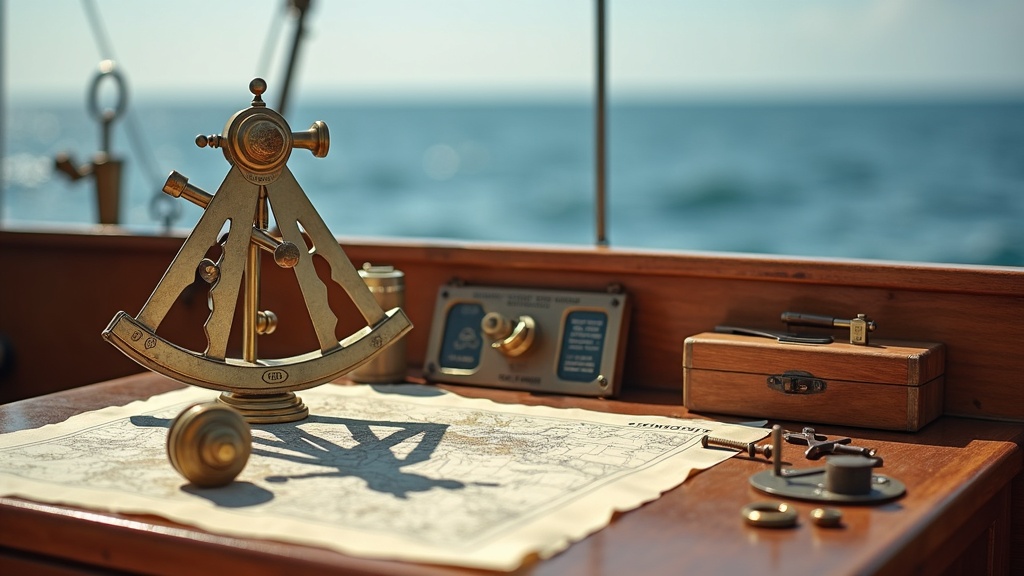
- Sextant: A precision device for measuring angles between celestial bodies and the horizon. Steady hands and consistent practice with a quality sextant are key to getting solid fixes.
- Nautical Almanac: Issued annually, this book lists coordinates for the sun, moon, planets, and plenty of stars for every hour and day. It’s the root of all my celestial calculations.
- Chronometer: I depend on an accurate clock set to Greenwich Mean Time (GMT). Even a small timing error can place my fix several nautical miles off.
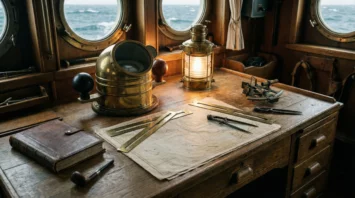
- Plotting Tools: Dividers, parallel rulers, pencils, and plotting sheets are must-haves for transferring calculations onto charts and visualizing my position.
The best celestial navigation tools are rugged and simple to use, even when a boat is rolling. I keep them clean and protected from salt and spray to ensure long life and accuracy.
How to Use Celestial Navigation: A Simple Workflow
I’ve found that actually learning celestial navigation comes down to regular, hands-on repetition. A straightforward routine helps me stay on course. Here’s my typical workflow at sea:
- Identify a Celestial Body: I pick a visible sun, moon, bright planet, or navigational star above the horizon for my measurement.
- Measure the Altitude: Using the sextant, I measure the angle between the bottom of the body (like the sun) and the visible horizon.
- Record the Time: I write down the exact second of the observation using my reliable chronometer.
- Consult the Nautical Almanac: This reference offers the precise position of the body at the time I took the sight.
- Determine My Line of Position: With some simple math and chart plotting, I draw a line on my chart showing all possible places I could be. By crossing two or more lines, I pinpoint my fix.
- Check and Correct: I often take multiple sights in a short time and double-check my entries and math, ironing out mistakes and improving my accuracy.
Practicing this routine helps make the workflow second nature, boosting confidence as I get more comfortable on every trip.
Leveling Up Celestial Navigation Skills: Tips and Common Hurdles
Like any practical craft, there are bumps along the learning path. Mastering the sextant, reading Almanac tables, and performing calculations on a bouncing deck all require patience. Here are tips that have helped me and many others:
- Steady the Sextant: Even the smallest shake can botch a sight. I support my arms on a rail and take several readings to average out errors.
- Sighting at Twilight: The best period for stellar sights is during dawn or dusk, when both horizon and stars are easily spotted.
- Double-Check the Numbers: Simple math mistakes or copying the wrong numbers from tables is a common pitfall. I make it a habit to check my steps as I go.
- Be Realistic: If I’m within one or two miles of my real position, I count it as a success. Conditions at sea aren’t always perfect.
Over time, every successful fix increases my self-assurance. The sun’s changing altitude can offer clues about latitude, while star patterns help out when all electronics go dark. The trick is to keep practicing until the method feels natural.
Advanced Celestial Navigation Techniques
Once I had the fundamentals down, I found jumping into advanced celestial navigation techniques both useful and interesting. Some of the established methods I use include:
- Lunar Distance: Before reliable chronometers, sailors measured the angle between the moon and a bright star for a time check. This is still handy if my clock fails, though it needs practice.
- Running Fixes: If I can’t get both the sun and the horizon at once, or weather changes fast, I take multiple sights at different times and factor in my own movement.
- Using Multiple Bodies: Shooting several stars at twilight cuts down plotting mistakes and gives a more precise fix.
- Star Knowledge: Knowing which stars stand out and where to find them takes the stress out of nighttime navigation.
Jumping into these advanced techniques has helped me grow as a navigator, especially on ocean passages when every skill counts as a backup.
Learn Celestial Navigation Online: Courses and Resources
Getting started used to mean tackling thick books or finding a willing salty skipper. Now, a ton of great information is available online. I’ve found a combination of self-study, structured courses, and hands-on learning delivers the best results. Here are recommendations that proved helpful:
- American Sailing Association offers guided lessons with Q&A and clear explanations for beginners and enthusiasts.
- Raymarine’s Celestial Navigation Blog breaks down hands-on guides and reviews of the latest navigation methods and tools.
- United States Power Squadrons provides traditional and online instruction for sailors at every level.
- YouTube channels run by experienced ocean sailors offer step-by-step video guides using real footage from the open water.
Online communities offer a great way to bounce questions, share stories, and get feedback. I always check the authority of the source, and I test lessons myself on a real boat to lock in my learning.
Frequently Asked Questions
I often get asked about jumping into celestial navigation. Here are a few of the questions—and quick takes—I hear the most:
Question: What’s the best way to start learning celestial navigation?
Answer: Read a basic guide or take a reputable online course, then practice measuring angles with a basic plastic training sextant before buying a real one. Work through plenty of sight reduction problems until the steps are burned in.
Question: How accurate is celestial navigation compared to GPS?
Answer: A good celestial fix usually puts me within a few nautical miles of my true position if my gear and methods are on point. GPS is way more precise, but having celestial skills keeps me on track if electronics conk out or lose signal.
Question: What tools or books do you recommend for beginners?
Answer: I always have the most up-to-date Nautical Almanac, a strong practice sextant, and a helpful guide like “Celestial Navigation for Yachtsmen” by Mary Blewitt or “The American Practical Navigator” (Bowditch). Older editions of Bowditch, free online, are super detailed and friendly for self-study.
Question: Can I really teach myself celestial navigation online?
Answer: Absolutely. With some patience and reliable resources, anyone can check out celestial navigation online. But practical practice on a real trip and comparing your results remains the key to making it stick for good.
Real-World Stories: How Celestial Navigation Pays Off
During an Atlantic crossing years ago, our GPS antennas went haywire after a week of rough seas. For the next four days, I turned to my sextant and Almanac to keep us on course until the electronics were fixed. My fixes came close enough that we spotted land exactly where expected. Another skipper told me about running aground after a GPS glitch gave him false confidence; now he makes sure every crew member knows basic celestial navigation.
Firsthand stories like these show how mastering classic navigation is more than just an old tradition. It keeps me ready, resourceful, and tuned in to the basics of open-ocean sailing.
Key Takeaways for Seafarers
Growing celestial navigation skills calls for patience, repetition, and the right attitude. The best approach for me has been using solid tools, sticking with a stepwise process, and routinely checking my outcomes. Even with my digital devices on board, these core techniques give me an extra level of safety and assurance. For anyone who is serious about offshore cruising, putting time into these skills really pays off in tough moments.
The sea can be unpredictable, but charting a course with the sky is always possible. It’s a lifelong skill and one I’m ready to pass along to anyone heading out on their next sailing adventure.






4 Comments
Thanks for sharing an informative article.
Celestial navigation is still valuable for seafarers because it provides a reliable backup when electronics fail and deepens awareness of position, time, and the natural environment. Using a sextant, almanac, and simple math strengthens confidence and seamanship, while connecting sailors to the long tradition of navigating by the sun and stars.
Keep up the good work!
Looking forward to your more posts.
Thank you so much for your thoughtful comment! I’m really glad you found the article informative.
You’re absolutely right—celestial navigation remains an invaluable skill, not just as a backup when electronics fail but also as a way to deepen a sailor’s connection to the sea, time, and nature. There’s something timeless and empowering about using a sextant and the stars, and it’s great to see others who appreciate that tradition.
I truly appreciate your encouragement.
More posts are on the way—stay tuned!
Excellent primer. What made celestial navigation click for me was treating it like a redundancy drill, not a museum skill. I log a weekly “no-GPS” hour, shoot a noon sight for latitude, and run a three-body fix at twilight. Biggest gains came from tight basics: honest index-error checks, careful dip correction, disciplined timekeeping, and writing every step in the sight workbook before touching a calculator. Practising on a lumpy sea taught me to average multiple sights and note heave; a cheap artificial horizon let me keep the muscle memory alive in port.
I pair HO 249 with a simple spreadsheet for sight reduction, but I always keep paper tables and a backup time source in the nav bag. Over time, the routine turned fixes from guessy to trustworthy—and made me calmer when the plotter misbehaves.
Marios
Marios, this is fantastic insight — thanks for sharing it. I really like the way you frame celestial nav as a practical redundancy routine rather than a historical curiosity. Your “no-GPS hour” is a great habit, and the emphasis on disciplined fundamentals—index error checks, dip, clean timekeeping, and step-by-step workbook entries—mirrors exactly what builds real confidence.
Your point about practising on a moving deck is spot-on too. Averaging sights and being honest about heave are the kinds of details that separate a rough fix from a dependable one. And keeping both HO 249 and a lightweight digital workflow in parallel is a smart balance between efficiency and resilience.
It’s encouraging to hear how your consistency turned celestial fixes into something calm and trustworthy. That’s the mindset I think more modern navigators would benefit from adopting.