Dead reckoning is one of the oldest navigation methods used even today. Whether I want to find my way at sea, in the air, or on land without GPS, understanding dead reckoning techniques helps me estimate my position effectively.
From traditional sailing ships to modern autonomous vehicles, the core ideas of dead reckoning have been adapted to fit many needs. In this article, I’m going to share practical dead reckoning navigation techniques, the main tools for dead reckoning, and how these principles can be used in everyday scenarios.
Check out some Dead Reckoning tools
Understanding Dead Reckoning Principles
The main goal of dead reckoning is to estimate a current location based on a previously known position. By tracking the direction of travel and the distance covered, I can predict where I am on a map, even without external references. Dead reckoning navigation typically involves simple math, direction-finding tools, and careful record keeping.
The name “dead reckoning” likely comes from the practice of using a deduced (but not directly observed) calculation of position, though its origins are open to debate. What is clear is that the concepts haven’t changed much over centuries. I start from a known point, track each change in direction and distance traveled, then update my estimated position with each leg of the trip. Since small errors add up over time, dead reckoning works best when I can occasionally check my estimate against landmarks or updates from other methods.
Key Dead Reckoning Techniques
There are several techniques that form the core of dead reckoning. If you’re looking to learn dead reckoning techniques, these form the backbone of your understanding:
- Measuring Distance Traveled: This involves tracking how far I have moved from the starting point. Common methods include timing my movement at a known speed, counting wheel turns in land vehicles, or using a log line at sea.
- Maintaining a Compass Heading: Keeping track of my direction with a compass ensures each segment of my adventure is recorded correctly. Any deviation from the planned heading needs to be noted and adjusted for later calculations.
- Breaking the Adventure into Legs: If the trip isn’t one straight line, I record each segment (“leg”) separately with its specific distance and direction. At the end, I combine all legs to estimate a final position.
- Account for Drift: In situations where wind, current, or other factors push me off course, I factor that extra movement into my calculations. Estimating leeway (the sideways drift) helps keep my dead reckoning position accurate.
- Frequent Plotting: I regularly update my position on a paper chart or digital map. This lets me spot if the estimate is going off track and adjust before the error grows too large.
All these dead reckoning navigation techniques depend on steady attention to detail and routine updates throughout an adventure. Even small mistakes, like misreading the compass or guessing the wrong speed, can pile up over time.
Essential Tools for Dead Reckoning
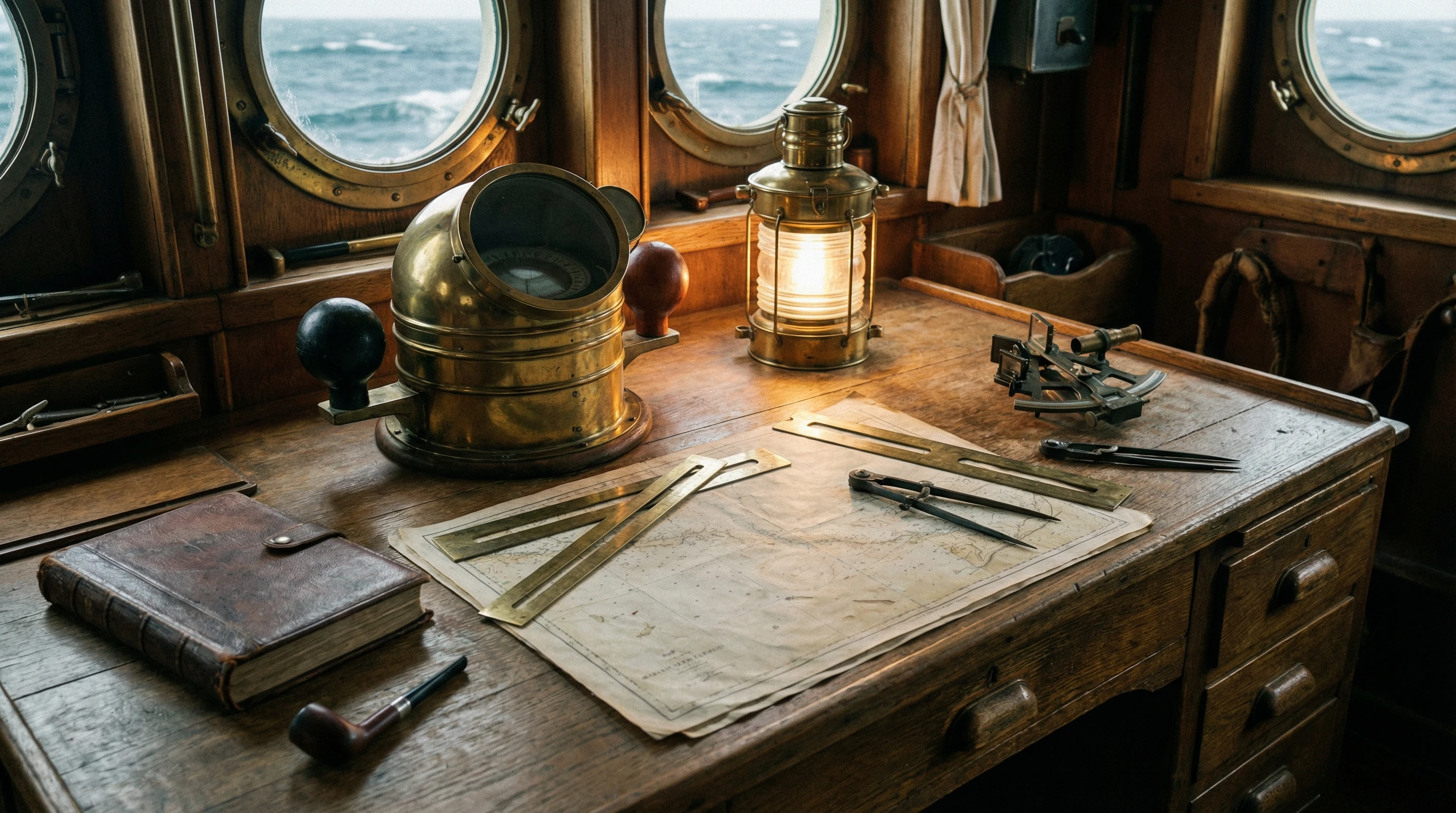
While dead reckoning can be done mentally in simple cases, specialized tools for dead reckoning help improve accuracy and make calculations easier. These are the main tools I keep in my navigation kit:
- Magnetic Compass: The classic navigation instrument, a compass lets me maintain a set heading over each leg of the adventure. There are many types, from handheld hiking compasses to sophisticated marine versions.
- Measuring Instruments: At sea, I use a log line or mechanical log to measure distance traveled. On land, odometers on vehicles or even step counters on foot give distance. In aviation, airspeed and time combine to give distance flown.
- Parallel Rulers or Plotting Tools: These help me transfer bearings and distances onto paper maps with accuracy. I can “walk” a compass bearing from one point to another using rulers or scales.
- Divider Compasses: Dividers help in measuring distances on maps or charts. By setting the points to a known scale, like one nautical mile, I can walk off a route and check specific legs.
- Protractor or Course Plotter: For measuring and plotting precise angles, these tools help lay out headings with accuracy.
- Notebooks or Logbooks: Consistent record keeping is very important. I note down every heading, speed, distance, and correction, so I can trace my route or troubleshoot if my estimate doesn’t match reality.
- Electronic Assist Tools: Many modern dead reckoning systems use inertial measurement units and onboard computers. These digital tools automate math but rely on the same principles as manual dead reckoning.
I’ve found that having good, reliable tools not only makes the calculations easier, they also save me a lot of errors over a long day of travel. Paper maps and manual instruments don’t rely on batteries. They offer a backup when electronics fail, making them invaluable in emergencies.
How to Apply Dead Reckoning in Different Scenarios
Dead reckoning isn’t limited to sailors or pilots. I can use these techniques in any situation where my exact path matters and GPS or landmarks aren’t available. Here are a few real-world examples:
- Hiking in Dense Forests: When GPS signals can’t reach through thick tree cover, I can use a compass and pace counting. If I know I’m 2,000 paces due north from my car, I can estimate my return path even without clear sightlines.
- Marine Navigation: On open water with limited visibility, I keep a running estimate of my position by tracking course and speed. Dead reckoning becomes especially useful when fog, cloud cover, or rough weather prevents using the sun or stars for navigation.
- Aviation: Pilots use dead reckoning alongside radio navigation. By tracking speed, heading, altitude, and wind correction, pilots estimate their location until radio signals or visual references appear.
- Autonomous Vehicles: Modern robots and self-driving cars blend sensor data to perform dead reckoning. Wheel encoders, gyroscopes, and accelerometers feed position changes into the onboard system, offering continuous location estimates, especially when GPS drops out.
- Urban Exploration: In subways, underground labyrinths, or huge buildings where GPS isn’t available, mapping my steps and directions lets me retrace my route and avoid getting lost.
Applying these techniques in different environments often means choosing specific tools and measuring methods that fit the challenges of that terrain. For instance, pace counting works best in forests, but a calibrated odometer is more accurate for vehicles.
Steps to Learn Dead Reckoning Techniques
If you’re looking to learn dead reckoning techniques, building skills is best done step by step. Here’s the process that worked best for me:
- Start with the Basics: Learn how to read a compass, estimate pace count (on foot), and measure time over distance. Simple exercises in your backyard or a local park build a strong foundation.
- Practice Plotting on Maps: Grab a paper map and practice drawing bearings and lines to simulate routes. Transfer this to real walks or drives and compare your estimate with your actual arrival point.
- Log Every Movement: Keep a notebook or digital log. Write down your starting point, heading, speed or pace, and time traveled for each leg of a route. Frequent updates train your attention and make detecting errors easier.
- Introduce Corrections: Once you’re comfortable with straight lines, add real-world obstacles. Practice adjusting for drift, detours, or changes in speed. This will help you adapt to unpredictable terrains and situations.
- Check Your Work: Whenever possible, compare your dead reckoning estimate to a known point—like a landmark, road, or GPS fix. This feedback tightens your accuracy over time.
With regular practice, these dead reckoning principles explained in theory become second nature in action. Confidence grows as your estimates line up with the real world, building your trust in your own navigation abilities.
Things to Consider When Using Dead Reckoning
Dead reckoning isn’t without its challenges. I’ve run into a few key issues over the years that anyone learning these methods should keep in mind:
- Accumulating Errors: Every small mistake in distance, speed, or bearing adds up over time. I always try to reset my estimate using a fixed reference as soon as one becomes available to reduce error growth.
- Human Factors: Fatigue, distraction, or simple slips can lead to missing a direction change or losing count of paces. This is why taking regular breaks and using good record-keeping habits matters a lot.
- Environmental Challenges: Wind, currents, rough terrain, or obstructions make estimations less reliable. Knowing when conditions are likely to throw off calculations helps me build in extra caution or corrections to my route.
- Tool Reliability: Compasses can be thrown off by metal objects or electronic interference. Mechanical logs and odometers may jam or slip. Routine checks help me spot problems early before they lead to major errors.
Even with these challenges, dead reckoning remains a valuable method, especially when other navigation tools aren’t available. Preparation and regular double-checking make a big difference in how dependable the estimates are.
Getting Accurate Distance Measurements
When I want more precision with distance, I choose the measuring tool based on the activity. Marine logs are good for boats, odometers work well for vehicles, and pace counting is practical on foot. Calibrating my step count ahead of time in various conditions gives me more confidence while hiking. For advanced work, a pedometer or wearable fitness tracker can help maintain accuracy over many miles spent outdoors.
Maintaining a Steady Heading
Using a compass requires some practice. Walking or traveling in a straight line isn’t as easy as it sounds, especially across open water or unmarked ground. I often pick out a feature ahead of me that lines up with my intended bearing, then walk toward it until I need to recheck. This leapfrogging approach keeps me from drifting off course in small, unnoticed ways and can be used effectively in open landscapes.
Compensating for Deviations and Drift
Currents, wind, and other outside forces change my planned path. Estimating the speed and direction of drift, then adding that as a correction factor, helps keep my estimated location closer to reality. Even a small sideways push adds up over a long adventure. In practice, I regularly check my heading and compare with the route plotted on my map or chart, then adjust as needed to prevent major errors.
I often compare dead reckoning to putting together a puzzle, where every piece—each heading, distance, and correction—gets me one step closer to my actual location. It’s about routine, awareness, and making the most out of simple tools. With practice, dead reckoning makes complex adventures manageable, even under difficult conditions.
Advanced Dead Reckoning Navigation Techniques
Once the basics feel comfortable, there are a few more advanced approaches I use to refine accuracy and tackle tougher challenges:
Combining Dead Reckoning with Other Methods: To keep my location estimates tight, I use dead reckoning alongside other navigation methods like celestial navigation or GPS. Using a “hybrid” approach means that if I lose signal or landmarks disappear, I’m not left guessing for long and can quickly reorient myself.
Inertial Navigation Systems (INS): These systems use combinations of gyroscopes, accelerometers, and sometimes magnetometers to track movement. Pilots and ships often use these as backups or main dead reckoning tools when crossing featureless areas like deserts or oceans, making the process smoother without constant manual input.
Digital Dead Reckoning: Modern smart devices merge dead reckoning with data from satellites, cell towers, and Wi-Fi to fill in the gaps whenever GPS is interrupted. This blending of data is common in vehicular and smartphone apps for more robust location tracking over time.
Probabilistic Dead Reckoning: Sometimes, I use statistical models (like Kalman filters) to estimate where I am when measurements have known errors. For example, robots and autonomous drones use these math tools to guess their positions with higher confidence when sensor data isn’t perfect or environmental conditions are rough.
Route Optimization and Simulation: Before starting out, I often pre-plan my route and simulate potential errors using mapping software. This helps me understand where dead reckoning might be strongest and where I’ll need to keep an eye out for error buildup, giving me peace of mind during travel.
Dead Reckoning in Real-World Applications
Dead reckoning is used in many industries today, often as a backup to GPS or to supplement navigation systems. Here’s where I see dead reckoning playing a valuable role:
- Marine Rescue: When locating a missing ship or lifeboat, search patterns often start from the last known position using dead reckoning to estimate where drift would place the missing craft and to define focused search areas.
- Aviation Safety: Aircraft crossing the ocean (out of radio contact) target specific waypoints using dead reckoning, then check in with radio fixes or satellites when signals resume, ensuring a higher level of safety during long flights.
- Space Exploration: Spacecraft use a more sophisticated version of dead reckoning, combined with inertial measurements and star tracking, to update position on long journeys between orbital fixes. This is essential when Earth-based communication is delayed or intermittent.
- Robotics and Drones: Robots and drones frequently rely on dead reckoning when GPS coverage fails indoors or underground, ensuring they can complete their missions accurately even in signal-dark environments.
The power of dead reckoning lies in its simplicity and adaptability. Even with high-tech systems, I always keep these principles in mind, so I have a plan if technology fails or is unavailable.
Frequently Asked Questions
Here are answers to some common questions people have when learning about dead reckoning techniques and tools:
Question: How accurate is dead reckoning compared to GPS?
Answer: Dead reckoning’s main limit is the buildup of small errors. Over short distances, it can be surprisingly accurate, especially when I double-check with physical landmarks or other reference points. Over longer distances without correction, even simple errors grow much bigger than GPS position errors.
Question: What tools should I buy if I want to learn dead reckoning techniques?
Answer: A good magnetic compass and simple notebook cover most situations. For more advanced work, a set of dividers, parallel rulers, and a paper map go a long way. Electronic tracking devices or smartphone apps can add convenience, but shouldn’t be your only system.
Question: Can I use dead reckoning indoors or underground?
Answer: Yes, dead reckoning is one of the only ways to estimate position where GPS does not reach. By tracking steps, headings, and turns, I can estimate relative position even in buildings, tunnels, or caves. This is why these skills are still so relevant today.
Question: What’s the best way to check for errors in dead reckoning?
Answer: Whenever I reach a known landmark or get a GPS fix, I mark the error between my estimate and the actual position. Regular checks prevent error buildup and help improve future accuracy.
Why Dead Reckoning Still Matters Today
Even though satellites and electronic navigation systems are everywhere, I’ve found that dead reckoning techniques are still super important to learn. When GPS fails or isn’t available, knowing how to estimate your location can keep you safe and confident in unfamiliar places. These skills also make my overall navigation stronger, since they push me to be aware of my surroundings and movement rather than just following a dot on a screen.
The equipment for dead reckoning is usually light and reliable, and the core principles are easy enough to learn with a bit of time and attention. I encourage anyone interested in outdoor navigation, boating, aviation, or technical robotics to spend time learning and practicing dead reckoning techniques. These methods remain an essential part of safe and successful travel.
Check out additional resources and tutorials from organizations like the U.S. Power Squadrons or your local navigation club for hands-on ways to practice these classic skills. Building your confidence step by step leads to safer adventures and more satisfying travel, no matter where your adventures take you.