Across the world’s oceans, thousands of seafarers go about their daily work in one of the most demanding and hazardous environments humanity has ever navigated. The difference between a ship that runs safely and one that risks lives often comes down to a single invisible force-safety culture. Understanding, building, and sustaining a genuine safety culture on ships is not just a regulatory obligation; it is the foundation of everything a professional mariner stands for.
What Is Safety Culture on Ships?
Safety culture on ships refers to the shared values, attitudes, perceptions, and behaviors that collectively determine how an organization, from the shipowner down to the rating on deck, approaches risk and safety in daily operations. It is not a poster on a bulkhead, nor a line in a safety management system manual. It is the lived reality of every officer, rating, and crew member making decisions under pressure, in high seas or confined spaces, at two in the morning when no superintendent is watching.
The International Safety Management (ISM) Code, adopted by the International Maritime Organization (IMO) and mandatory under SOLAS, is the regulatory backbone for safety management at sea. But regulations alone cannot manufacture culture. Culture is built through leadership, communication, trust, and continuous reinforcement. A ship where the Master genuinely listens to the AB’s hazard observations has a stronger safety culture than one whose toolbox talks are ticked off hurriedly before a job begins.
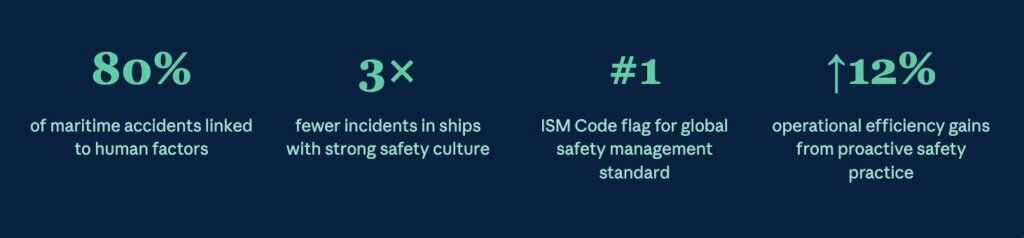
Research consistently shows that the majority of maritime accidents are attributable to human factors, errors in judgement, poor communication, fatigue, and a reluctance to speak up. Addressing these root causes is precisely what creating a safety culture on ships is designed to achieve.
How Safety Culture Impacts Ship Performance
The link between how safety culture impacts ship performance and the bottom line of maritime operations is well established. Ships that invest in building a genuine safety-first environment experience fewer incidents, lower crew turnover, better port-state control inspection results, and improved cargo-handling efficiency. Insurance premiums tend to be lower, and P&I club claims are reduced significantly when crews are trained to identify and report near-misses rather than hide them.
From a human perspective, the benefits are equally clear. Crew members who feel genuinely safe, heard, and empowered to raise concerns go home at the end of their contracts. Their families receive them whole. The psychological burden carried by seafarers in unsafe environments, anxiety, hypervigilance, and suppressed hazard reporting is a hidden cost that never appears on a voyage account but registers in every aspect of a ship’s operation.
The Pillars of Best Practices for Ship Safety Culture
Building best practices for ship safety culture requires attention to several interconnected pillars. None of these pillars works in isolation — they must be developed and reinforced together to create a genuinely resilient safety environment at sea.
Leadership commitmentMasters and officers who model safe behavior in every task
Open communicationCrews empowered to report hazards without fear of reprisal
Ongoing trainingRegular, relevant, and engaging safety culture training for maritime crews
Near-miss reportingSystems that capture and learn from incidents before they escalate
Continuous improvementRegular assessment and revision of safety procedures
Crew involvementEvery rank contributes to safety decisions and reviews
Top Strategies for Ship Safety: What Works at Sea
When examining top strategies for ship safety, it quickly becomes clear that the most effective approaches are also the most human-centred. Here are the strategies that maritime safety professionals and experienced seafarers consistently identify as most impactful.
1. Lead from the bridge down
The Master sets the tone for every aspect of shipboard life. When the Captain participates in safety drills with genuine engagement, conducts thorough pre-task briefings, and visibly prioritizes safety over schedule pressure, the message resonates throughout the entire crew. Leadership is not about authority, it is about example. Officers who take shortcuts teach their subordinates that shortcuts are acceptable. The reverse is equally true.
2. Make near-miss reporting the norm, not the exception
One of the most powerful cultural shifts any vessel can make is transforming near-miss reporting from a bureaucratic burden into a valued contribution. Crew members who report near-misses should be acknowledged and thanked. The information gathered from near-miss reports is among the most valuable safety data a ship can possess; it reveals risks before they become accidents. A blame-free reporting environment is an essential prerequisite for how to improve safety culture on board.
3. Invest in quality toolbox talks and pre-task risk assessment
A genuine toolbox talk is a focused, specific discussion about the hazards of a particular task on that day in those conditions, not a general recitation of policy read from a laminated card. Effective pre-task risk assessment involves every worker in the job, gives them the opportunity to identify concerns, and adjusts the plan if necessary. When this process is taken seriously, crew members internalize risk thinking as a natural part of their daily work routine.
4. Embrace STOP WORK authority at every rank
Every person on board, from the Chief Officer to the most junior ordinary seaman, must feel genuinely empowered and encouraged to stop a task when they believe it is unsafe. This is perhaps the hardest cultural norm to establish because it runs against deeply embedded hierarchical patterns in maritime workplaces. But when stop work authority is real rather than theoretical, it creates one of the most effective layers of protection against catastrophic incidents.
5. Create regular, meaningful safety meetings
Weekly safety meetings should be genuine forums for discussion, not agenda items to check off before dinner. The most effective safety meetings invite crew members to share observations, discuss incidents that happened on other vessels (using lessons learned from maritime databases such as MARS or the UK MAIB), and review upcoming operations with potential risks. Rotating the chairperson across ranks helps to build ownership across the crew.
6. Use behavior-based safety observation systems
Behavior-based safety (BBS) programs give crew members structured tools to observe each other’s work, provide constructive feedback, and identify systemic issues that formal audits might miss. When implemented respectfully, as a support system rather than a surveillance mechanism, BBS programmes significantly improve safety performance and create a culture of mutual accountability that supports ship safety culture improvement strategies over the long term.
Safety Culture Training for Maritime Crews
Safety culture training for maritime crews must go beyond procedural knowledge to address the attitudes and behaviours that underpin safe practice. The most effective training programmes in the maritime sector share several characteristics that distinguish them from tick-box compliance exercises.
- They are scenario-based, drawing on real incidents from the sector and the vessel type concerned
- They actively involve participants rather than presenting information passively
- They address human factors explicitly, fatigue, communication breakdowns, situational awareness, and confirmation bias
- They are delivered in the crew’s working language with attention to multicultural crews
- They include senior officers, not just ratings, culture cannot be built from the bottom up alone
- They are followed up with reinforcement activities and on-the-job observation
- They are regularly updated to reflect lessons from recent incidents and near-misses
The STCW Convention, as amended by the Manila Amendments, requires specific competencies in leadership and teamwork for officers. These requirements recognise that technical skill alone is insufficient, the ability to lead, communicate, and build a safe team environment is a professional competency that must be developed and maintained throughout a seafarer’s career.
Digital learning platforms now offer significant opportunities to deliver engaging, interactive safety culture training for maritime crews between voyages and during off-watch periods. Blended learning models that combine online modules with structured on-board discussion are particularly effective for multinational crews.
Shipboard Safety Culture Assessment: Measuring What Matters
Shipboard safety culture assessment is the process of systematically evaluating a vessel’s current safety culture to identify strengths, gaps, and opportunities for improvement. Assessment tools range from validated survey instruments to structured observation protocols and interview-based diagnostic reviews.
Effective assessment must measure what actually matters, not just whether procedures exist, but whether they are followed in practice, whether crew members feel comfortable raising concerns, and whether safety information flows effectively between ranks and departments. Key indicators to assess include:
- Near-miss reporting rates and trends over time
- Crew participation in safety meetings and drills beyond the minimum required
- Results of anonymous crew attitude surveys on safety climate
- Frequency and quality of safety conversations between officers and crew
- Rate of safety-related suggestions from crew members
- Port state control deficiency trends
- Incident investigation quality and close-out timeliness
Companies that conduct regular, transparent shipboard safety culture assessments, and feed the results back to crews with visible action plans, demonstrate the kind of organizational commitment that drives genuine, sustained improvement.
Ship Safety Culture Improvement Strategies: The Long Game
Lasting ship safety culture improvement strategies are not quick fixes. Culture changes slowly, and any initiative that does not have sustained senior management commitment will lose momentum within a voyage cycle or two. The most successful long-term improvement programmes share a common architecture.
They begin with an honest baseline assessment, not an assumption that current culture is acceptable. They set specific, measurable cultural targets alongside operational safety KPIs. They build in regular review points where progress is evaluated and celebrated, and where obstacles are identified and addressed. They create feedback loops between ship and shore that are genuinely two-directional, ships sharing insights with the company, and the company responding visibly to what it hears.
Perhaps most importantly, the best ship safety culture improvement strategies are patient. They recognise that a crew member who has spent years in an environment where hazard reporting was unwelcome will not become a confident reporter overnight. Trust is earned incrementally, through consistent positive responses to every safety communication. When the first officer thanks the AB for flagging a worn mooring line, and the worn line is replaced a small but real deposit is made in the account of safety culture.
Creating a Safety Culture on Ships: The Master’s Role
No discussion of creating a safety culture on ships is complete without addressing the unique and irreplaceable role of the ship’s Master. The Master is simultaneously the company’s representative, the safety officer responsible under ISM, the operational decision-maker, and the de facto cultural leader of the shipboard community.
Masters who create genuine safety cultures understand that their most powerful tool is not authority but credibility. They earn trust by making safety decisions that are sometimes commercially inconvenient. They take the time to understand the specific hazards faced by each department. They conduct meaningful, not perfunctory, safety rounds. And when something goes wrong, they respond with curiosity and a desire to understand rather than blame and punish.
The most respected Masters in the profession share a quality that might seem unremarkable: they are genuinely interested in the safety of every person on their ship. That interest, communicated through daily behaviour over an entire career, is the most powerful driver of safety culture that the maritime world has ever discovered.
Key Takeaways
Safety culture on ships is built through sustained leadership, open communication, meaningful training, and honest assessment. It cannot be mandated, only modeled, nurtured, and continuously reinforced. Ships that invest in their safety culture protect their crews, protect their cargo, and consistently outperform their peers on every operational metric. For every seafarer who reads a hazard report, attends a meaningful toolbox talk, or stops a job because something feels wrong, the culture is being built one decision at a time.
This article was created with AI assistance and reviewed by a human editor.







4 Comments
It is scary to see that 80 percent of marine accidents are caused by human error, which is why safety must be one of the most important factors on board a ship. I have a friend who works on a cruise ship and he says there are endless safety drills for staff and even passengers in case of emergencies, and it is important that the staff know what to do in every event.
I was just curious to know how often these emergency procedures are checked out by outside companies, as there is always room for improvement, no matter how good your systems are.
That 80 percent figure is striking and shifts the conversation in an important direction, because it means the biggest safety gains won’t come from better equipment alone but from better training, communication, and decision-making under pressure. Your friend’s experience on the cruise ship actually reflects one of the stronger safety cultures in the maritime industry, partly because cruise lines operate under intense public scrutiny and partly because they carry thousands of passengers who need to be drilled quickly and clearly in an emergency. The repetition of those drills might feel endless from the inside, but that muscle memory is exactly what allows people to act calmly and correctly when genuine panic is setting in around them.
To your question about external oversight, it’s actually more structured than many people realize. Ships operating internationally are subject to inspections under the ISM Code, which is administered by flag state authorities and verified by classification societies such as Lloyd’s Register, Bureau Veritas, and DNV. Port State Control inspections add another layer, in which inspectors in each country can board vessels and independently check safety systems, documentation, and crew competency, regardless of what the shipping company self-reports. On top of that, many companies voluntarily bring in third-party safety auditors to stress-test their procedures beyond what’s required.
That said, the frequency and quality of those inspections can vary by flag state and port, and, as you rightly pointed out, there is always room for improvement. The best companies treat external audits not as a compliance hurdle but as a genuine opportunity to find the gaps their own familiarity might be hiding. That mindset shift from passing inspection to genuinely improving is what really separates leaders from the rest.
Safety culture really does decide what kind of ship people are working on, because rules alone mean nothing if the crew is scared to speak up. I worked in a job before where people stayed quiet about problems just to avoid getting blamed, and that always made things worse later. The part about near-miss reporting without punishment made a lot of sense to me because small warning signs are usually ignored until somebody gets hurt. Do you think shipping companies actually support stop-work authority when delays could cost money? And how often do crews get real safety training instead of just checking boxes for inspections? In my opinion, the best captains are the ones who listen to the crew instead of acting like they already know everything.
Thank you for sharing that. Your experience perfectly illustrates the core problem. When blame is the default response to bad news, people stop delivering bad news, and the risks don’t disappear, they just go underground until they become crises. That’s exactly the dynamic that makes safety culture so much more important than safety rules.
Your question about stop-work authority is one I think about a lot, and I’ll be honest, it’s complicated. In theory, every reputable shipping company endorses it. In practice, when a vessel is behind schedule and port fees are ticking, the pressure on a crew member to stay quiet and push through can be enormous, even without anyone explicitly saying so. The best companies work hard to eliminate that unspoken pressure by making it crystal clear that a job that is stopped due to a documented safety concern will never be penalized, regardless of cost. But that commitment has to come from ownership level, not just a policy binder, otherwise it evaporates the moment money is on the line.
On training, you’re right to be skeptical. Checkbox training is unfortunately widespread because it satisfies auditors without requiring real cultural investment. Genuine safety training involves uncomfortable drills, honest debriefs, and leaders who model vulnerability by admitting their own near-misses. That last point connects directly to what you said about the best captains listening rather than performing authority. Crews follow leaders who demonstrate that good judgment includes knowing what you don’t know. That kind of humility at the top filters down and makes everyone on board safer.