Bringing new crew members aboard a vessel is far more than a logistical exercise. It is the foundation upon which operational safety, team cohesion, and regulatory compliance are built. Implementing best practices for training ship crew can mean the difference between a well-functioning team that responds effectively under pressure and a fragmented workforce in which critical knowledge gaps become dangerous liabilities at sea.
The International Maritime Organization (IMO) and the Standards of Training, Certification and Watchkeeping (STCW) Convention set the baseline for seafarer competence. Yet effective onboarding goes well beyond regulatory compliance. It requires structured mentorship, practical demonstration, cultural integration, and continuous assessment, all tailored to the unique demands of life and work aboard a vessel.
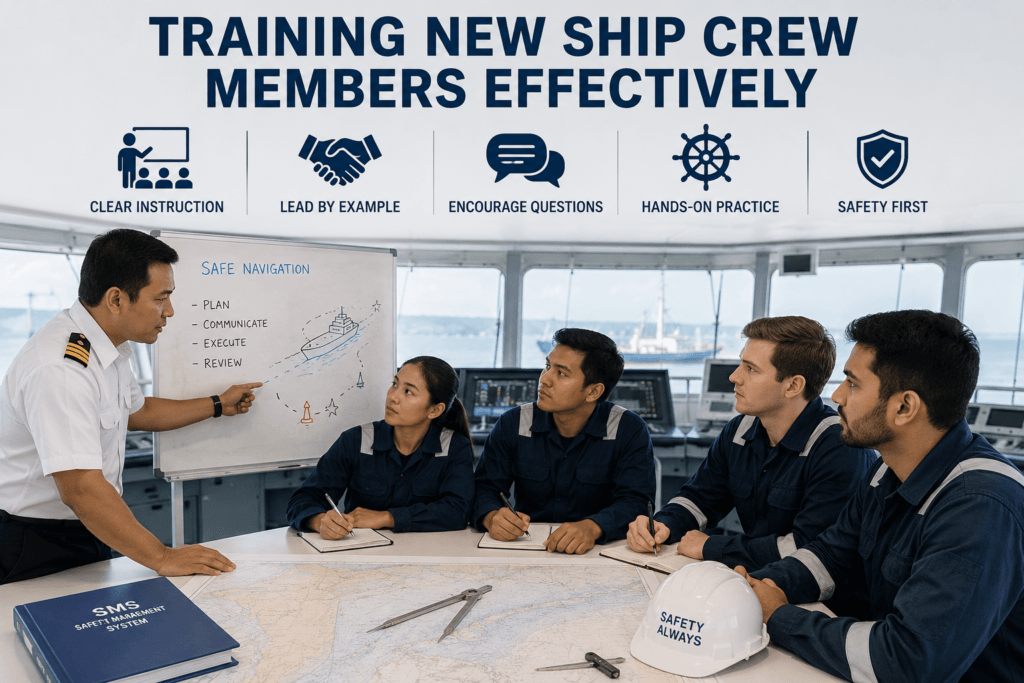
This guide explores the most effective methods for onboarding and training new ship crew members, drawing on maritime industry standards and practical experience from vessel operations worldwide.
Understanding the Scope of Maritime Crew Training
Before diving into specific methods, it is important to understand what effective maritime training actually encompasses. Ship crew onboarding is not a single event; it is an ongoing process that spans a new seafarer’s first days aboard through their first full contract and beyond.
Training aboard a vessel must address several interconnected areas:
- Safety and emergency procedures specific to the vessel
- Watchkeeping duties and navigational or engineering responsibilities
- Equipment operation and maintenance protocols
- Communication procedures and reporting structures
- Company policies, ISM Code compliance, and SMS (Safety Management System) requirements
- Environmental regulations, including MARPOL compliance
- Cultural integration and teamwork dynamics
A structured new-crew-member onboarding program ensures that no area is overlooked, regardless of the seafarer’s rank or experience level. Even experienced officers and ratings joining a new vessel require vessel-specific familiarisation that cannot be assumed from prior service.
Best Practices for Training Ship Crew: Core Principles
1. Start Before They Step Aboard
Effective seafarer training begins before a crew member sets foot on the gangway. Pre-joining documentation — including vessel-specific SMS manuals, familiarisation checklists, and emergency procedure summaries — should be shared with new joiners well in advance of their joining date.
Some shipping companies have adopted e-learning platforms that allow new crew members to complete vessel familiarisation modules online before joining. This approach reduces the knowledge gap on arrival and allows the onboard training period to focus on practical, hands-on skill development rather than basic orientation.
2. Structured Familiarisation Checklists
STCW regulations require vessel familiarisation for all new crew, but the quality of that familiarisation varies widely across the industry. The most effective ship crew onboarding processes use detailed, rank-specific checklists that must be signed off by both the new crew member and a responsible officer.
These checklists should cover the location and operation of all life-saving appliances, fire-fighting equipment, muster stations, and emergency escape routes. They should also include procedures for reporting near-misses, accidents, and non-conformances in line with the ship’s SMS and ISM Code requirements.
Crucially, familiarisation should not be treated as a box-ticking exercise. Officers responsible for signing off checklists must verify understanding — not simply witness a signature.
3. Assign a Dedicated Mentor or Buddy
One of the most impactful best practices for training ship crew is assigning a designated mentor, an experienced crew member of a similar rank who guides the newcomer through their first weeks aboard. This buddy system accelerates practical learning, reduces anxiety in an unfamiliar environment, and helps new seafarers integrate into the vessel’s social fabric.
Mentors should be selected carefully. Not every experienced crew member makes an effective trainer. The best mentors are patient, communicative, and genuinely committed to the development of their colleagues. Where possible, consider the linguistic and cultural background of both mentor and mentee to facilitate clearer communication — particularly important on multicultural vessels where English may be a second language for many crew members.
For a deeper understanding of the challenges that arise aboard vessels with diverse crews, see our article on managing multicultural crew dynamics effectively.
Practical Maritime Training Methods That Work
Demonstrate, Then Supervise, Then Trust
The most effective maritime training methods follow a simple yet powerful progression: the trainer demonstrates the task, the trainee performs it under supervision, and then the trainee is trusted to perform it independently, with periodic checks.
This model applies to everything from cargo securing and mooring operations to engineering watchkeeping and engine room rounds. Rushing through this progression, particularly skipping the supervised stage, is a leading cause of operational errors and incidents aboard vessels.
Drills as Training Opportunities
SOLAS requires regular drills aboard all vessels, fire drills, abandon ship drills, man-overboard drills, and others. These drills are not merely regulatory requirements; they are among the most valuable training tools available to ship operators.
New crew members should be fully integrated into drills from their first week aboard, even if they are still in the familiarisation phase. Participation in realistic drill scenarios builds muscle memory, reinforces emergency procedures, and identifies gaps in understanding before a real emergency arises.
After each drill, a structured debrief led by the Master or Chief Officer should include input from all participants, including new crew members. This not only improves future drill performance but signals to newer seafarers that their observations and questions are valued.
On-the-Job Training Records
Maintaining accurate on-the-job training records is essential — both for compliance purposes and as a management tool. Training logs should document which tasks a new crew member has been trained on, the date and method of training, and the name of the trainer who verified competence.
These records also serve as a foundation for future professional development conversations. When senior officers can review a crew member’s training history, they can identify areas requiring refresher training and plan career progression conversations with greater precision.
Addressing the Human Factor in Crew Training
The maritime industry has long recognized that the human factor is the leading contributor to accidents and incidents at sea. Effective seafarer training must therefore go beyond technical competence and address the psychological, social, and physiological aspects of working aboard a vessel.
New crew members, regardless of experience level, face significant adjustment challenges: adapting to shift work patterns, managing isolation from family, integrating into an existing social hierarchy, and performing under the pressure of being ‘the new person.’ Trainers and senior officers should be conscious of these pressures and create a training environment that is supportive rather than intimidating.
Fatigue management is a critical component of this picture. A crew member struggling with sleep disruption during their first week aboard is less able to absorb training material and more prone to errors. Training schedules should account for rest hour requirements under MLC 2006 and STCW, ensuring that training activities do not encroach on mandatory rest periods.
To explore this topic further, read our in-depth guide on crew fatigue management strategies for modern vessels.
The Role of Technology in Modern Seafarer Training
The shipping industry is increasingly embracing digital tools to enhance the ship crew onboarding process. From tablet-based SMS access and digital familiarisation checklists to video-based training modules and simulator refresher programs, technology is transforming how maritime knowledge is transferred aboard vessels.
Simulation-based training, in particular, offers significant advantages for new crew. Simulators allow seafarers to practice complex procedures, berthing maneuvers, engine-room casualty responses, and cargo operations — in a controlled environment where mistakes carry no real-world consequences. Many Flag States and classification societies now recognize simulator-based training as fulfilling specific STCW competence requirements.
However, technology should complement, not replace, hands-on, vessel-specific training delivered by experienced seafarers. No simulator can fully replicate the sensory and social environment of an operating vessel, and digital checklists cannot substitute for genuine officer engagement with new crew members.
Building a Culture of Continuous Learning
The most effective ship operators recognize that training does not end after the initial onboarding period. Building a culture of continuous learning — where every crew member, from cadet to Master, is expected to keep developing their knowledge and skills — dramatically improves both safety outcomes and crew retention.
Toolbox talks, safety committee meetings, and lessons-learned briefings are all practical mechanisms for embedding a learning culture into daily vessel life. When senior officers openly share their learning and constructively acknowledge past mistakes, they signal to newer crew members that curiosity and honest reporting are valued, not penalized.
Companies that invest consistently in their crew’s professional development also benefit from stronger loyalty and lower turnover, a significant operational advantage in a global seafarer market where experienced personnel are in high demand.
Conclusion
Implementing the best practices for training ship crew requires genuine commitment from ship operators, fleet managers, and vessel officers. It demands structured systems, cultural awareness, mentorship, and a willingness to treat every new crew member as a long-term investment rather than a temporary resource.
From pre-joining familiarisation to on-the-job mentorship and continuous professional development, the most effective maritime training methods are those that respect the complexity of life at sea and the full humanity of the seafarers who choose it as their profession. When new crew members feel genuinely supported in their development, the results- safer vessels, higher performance, and stronger teams- speak for themselves.
This article was created with AI assistance and reviewed by a human editor.







2 Comments
What a fascinating exploration of maritime training. I had no idea of the structure of training being as important as the training itself. With technology driven training being just one rung in the process, they can reinforce the drills and training within a controlled environment that allow for freedom of decision making without the high cost that real life human error can cause.
Thank you for such a thoughtful response! You’ve touched on something that many people outside the maritime world rarely consider: that the how of training matters just as much as the what. The structural framework behind seafarer education isn’t just bureaucratic formality; it’s carefully designed to mirror the complexity of real shipboard decision-making.
You’re absolutely right that technology-driven training shines brightest when it creates that controlled space for consequence-free mistakes. A mariner who has navigated a simulated engine room emergency three times is far better prepared when the real alarm sounds at 0300 in the middle of the North Atlantic. That psychological readiness, built through layered, structured repetition, is something no single training method can achieve on its own. It truly takes the whole framework working together.