The modern maritime industry is one of the most internationally diverse working environments on the planet. On any given vessel sailing the world’s oceans, crew members may hail from the Philippines, India, Eastern Europe, West Africa, Southeast Asia, and a dozen other nations, all working together in close quarters under demanding conditions. Managing multicultural crew dynamics is therefore not merely a soft skill; it is a core operational competency. Understanding how cultural backgrounds shape communication styles, perceptions of authority, risk tolerance, and interpersonal behavior is essential for ship officers, fleet managers, and maritime training institutions alike.
This article explores the key dimensions of multicultural crew dynamics, how cultural diversity in teams affects performance at sea, the communication challenges that arise in diverse crews, and the practical strategies that maritime organizations can use to manage and leverage diversity effectively.
What Are Multicultural Crew Dynamics?
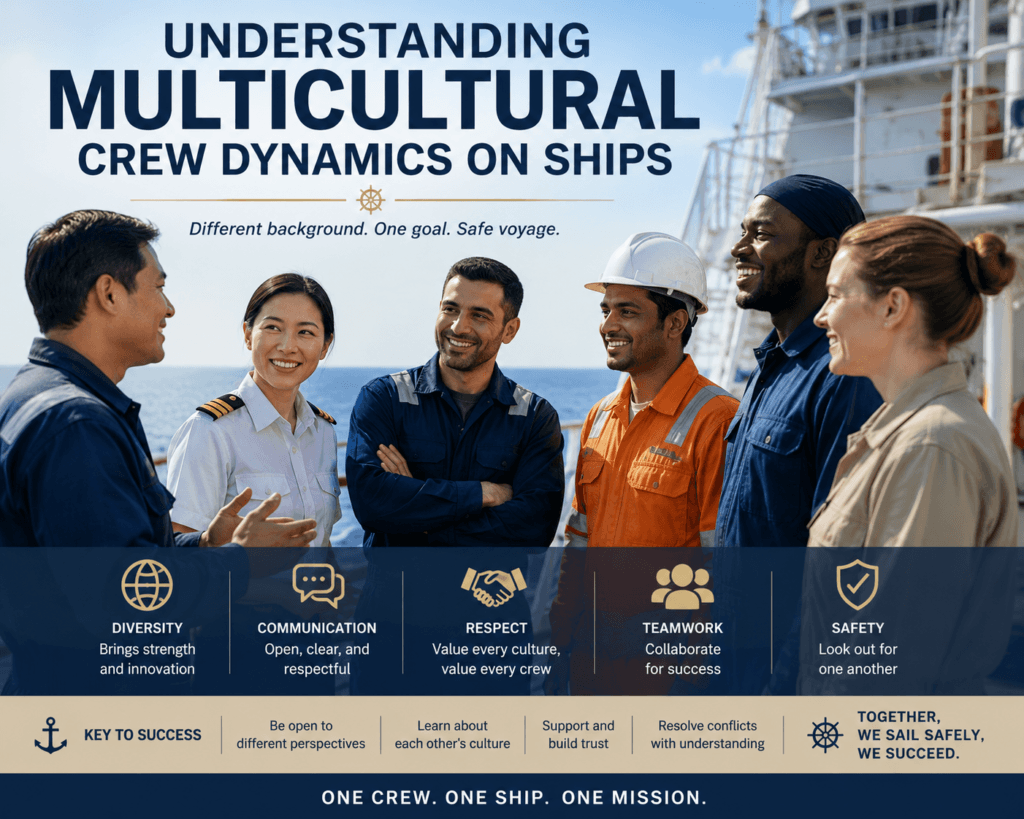
Multicultural crew dynamics refer to the patterns of interaction, communication, hierarchy, and group behavior that emerge when individuals from different national, linguistic, and cultural backgrounds work together aboard a ship. These dynamics are shaped by deeply ingrained cultural values, values that often operate below conscious awareness and govern how people respond to authority, express disagreement, handle stress, and collaborate.
Hofstede’s cultural dimensions theory provides a useful lens for understanding team dynamics in maritime settings. Crews from high-power-distance cultures (such as parts of Southeast Asia or the Middle East) may be less likely to challenge a superior’s decision, even when they perceive a safety risk. Crews from more individualistic cultures (such as Northern Europe or North America) may be more assertive and proactive in raising concerns. These differences, if unmanaged, can become friction points or, worse, contribute to maritime accidents and miscommunications.
Understanding team dynamics in this context means recognizing that behavior aboard a vessel is rarely purely individual; it is culturally mediated. A seafarer who appears passive or overly agreeable may not be disengaged; they may be expressing deference in a culturally appropriate way. A crew member who questions instructions directly may not be insubordinate; they may simply be operating from a culture where open dialogue is expected.
The Role of Cultural Diversity in Teams at Sea
Cultural diversity in teams carries both significant advantages and real challenges. In the maritime context, these tensions play out in a uniquely pressurized environment where poor communication can result in collision, grounding, cargo loss, or loss of life.
Advantages of diverse crews include:
- A broader range of problem-solving approaches and perspectives, which can enhance decision-making during complex navigational or technical challenges.
- Multilingual capabilities that can be invaluable in port communications across different regions of the world.
- Greater adaptability and resilience, as crew members experienced in different maritime traditions bring a range of practical skills.
- Potential for cultural bridge-building, improving the organization’s relationships across global port communities.
Challenges of diverse crews include:
- Language barriers impede the precise, rapid communication required during emergencies.
- Differing assumptions about workplace hierarchy, personal space, and acceptable risk levels.
- Misinterpretation of non-verbal cues, tone, and indirect language.
- Potential for in-group formation along national or linguistic lines, which can fragment crew cohesion.
The International Maritime Organization (IMO) has long recognized these tensions. Standards of Training, Certification and Watchkeeping (STCW) conventions increasingly incorporate requirements around cross-cultural competence and human element training, acknowledging that technical skill alone cannot guarantee safe ship operations in a multicultural environment.
Effective Communication in Multicultural Teams
Effective communication in multicultural teams is arguably the single most important factor in safe and efficient ship operations. Communication failures are found in the majority of maritime accident investigations, and cultural and linguistic factors are consistently cited as contributing factors.
The IMO mandates English as the working language at sea, but fluency levels vary considerably across international crews. More importantly, even when all crew members speak English, cultural differences in communication style can create misunderstandings. High-context cultures (where meaning is embedded in tone, context, and implication) versus low-context cultures (where meaning is stated explicitly and directly) create constant opportunities for misinterpretation.
For example, a crew member from a high-context culture might respond to an instruction with “I will try” as a polite way of indicating that the task is not feasible, whereas an officer from a low-context culture might hear it as a commitment. Such disconnects can delay corrective action and create dangerous situations.
Strategies to support effective communication in multicultural teams aboard ships include:
- Using standardized maritime English phrases (IMO Standard Marine Communication Phrases) consistently across all watches and operations.
- Encouraging closed-loop communication, where instructions are repeated back to confirm understanding, as a routine practice rather than an emergency measure.
- Creating psychologically safe environments where crew members feel empowered to ask for clarification without fear of embarrassment or professional repercussion.
- Briefing and debriefing sessions that create structured opportunities for all crew voices to be heard, regardless of cultural communication norms.
- Awareness of non-verbal communication differences, particularly for crew members interacting across high-context and low-context cultural boundaries.
How to Manage Diversity in Teams: Practical Approaches
Knowing how to manage diversity in teams at sea requires more than good intentions. It demands structured processes, skilled leadership, and organizational commitment. The following approaches have proven effective across commercial shipping, naval operations, and offshore industries.
- Build Cultural Awareness at Every Level
Officers and ratings alike benefit from basic cultural awareness training before joining a diverse vessel. Understanding that a Filipino crew member may avoid direct eye contact with a senior officer as a sign of respect, not evasion, or that a Ukrainian engineer may communicate bluntly without intending offense, helps defuse unnecessary interpersonal tension before it escalates.
- Establish Clear Shared Norms
Vessels should have explicitly stated behavioral norms that transcend individual cultural preferences. Safety protocols, watch routines, and emergency procedures must be framed not as “our way” but as “the vessel way” — a shared professional code that every crew member is inducted into upon joining, regardless of their background.
- Promote Inclusive Leadership
Masters and chief officers set the cultural tone for the vessel. Inclusive leaders actively seek input from all crew members during planning, demonstrate respect for cultural differences, and address exclusionary behavior quickly. They understand that managing multicultural crew dynamics is an ongoing practice, not a one-time orientation.
- Address Conflict Proactively
Cultural misunderstandings left unaddressed tend to calcify into resentment and clique formation. Vessels should have accessible, confidential channels for crew members to raise interpersonal concerns, and officers should be trained in culturally sensitive mediation techniques.
Impact of Multicultural Teams on Performance
Research into the impact of multicultural teams on performance points consistently to a nuanced picture: diversity can enhance or impair performance depending on how well it is managed. In the maritime sector, poorly managed diversity is associated with higher rates of interpersonal conflict, communication errors, and near-miss incidents. Well-managed diversity, by contrast, has been linked to greater problem-solving capacity, improved situational awareness, and stronger overall crew cohesion.
A landmark study by the Nippon Foundation and World Maritime University found that human error accounts for the majority of maritime accidents, with organizational and cultural factors playing a significant enabling role. Crews that scored higher on cultural integration, where members reported feeling respected and included regardless of nationality, showed measurably better safety compliance and incident reporting rates.
The commercial implications are equally significant. Vessel efficiency, cargo care, port turnaround times, and crew retention rates are all influenced by the quality of crew relationships. High attrition, often driven by interpersonal dissatisfaction in diverse crews, represents a substantial ongoing cost for shipping companies. Investing in the management of multicultural crew dynamics, therefore, has a direct and measurable return on investment.
Training for Multicultural Team Dynamics
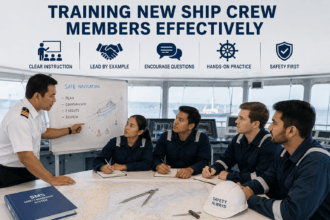
Training for multicultural team dynamics has evolved significantly in recent decades. Early approaches focused narrowly on “culture shock” awareness and basic etiquette differences. Modern maritime training programs take a far more integrated approach, embedding cultural competence within broader crew resource management (CRM) and leadership and management modules.
Effective training programs in this area typically incorporate:
- Scenario-based learning that places crew members in simulated multicultural team situations, requiring them to navigate communication breakdowns and cultural misreadings under realistic time pressure.
- Cultural self-awareness exercises that help participants identify their own cultural assumptions and communication defaults, not just those of other nationalities.
- Bridge and engine room simulation exercises where culturally diverse teams must coordinate responses to emergencies, with debrief analysis focused on how cultural factors influenced decision-making.
- Soft skills development, including active listening, feedback delivery, and inclusive questioning techniques, is framed specifically within cross-cultural maritime contexts.
- Continuous learning tools, such as digital modules and case study libraries, that allow crew members to engage with cultural competence content during voyages.
Leading maritime training institutions such as the World Maritime University, IAMU member institutions, and specialist providers like the Mintra Group and Seagull Maritime have developed robust curricula in this area. Regulatory bodies are increasingly incorporating cultural competence benchmarks into certification requirements, recognizing that the soft dimensions of crew performance are inseparable from hard safety outcomes.
Conclusion
The ships of today and tomorrow will continue to be crewed by men and women from every corner of the globe. This is one of the maritime industry’s greatest strengths and one of its most enduring management challenges. Multicultural crew dynamics are not an occasional issue to be handled when conflict arises; they are a permanent feature of the operational landscape that must be actively and intelligently managed.
Understanding team dynamics in the context of cultural diversity means moving beyond tolerance and towards genuine competence. It means designing vessels, procedures, and training programs with cultural complexity in mind from the outset. It means developing officers who are as comfortable navigating cultural difference as they are navigating the oceans.
The impact of multicultural teams on performance is ultimately determined not by the diversity itself but by the quality of leadership, communication, and organizational culture surrounding it. When these factors align, multicultural crews are not merely functional; they are among the most resilient, resourceful, and high-performing teams in any industry. In this light, the investment in training on multicultural team dynamics is not a cost but a strategic imperative for every forward-looking maritime organization.
This article was created with AI assistance and reviewed by a human editor.





2 Comments
Very insightful article! Working on a ship with a multicultural crew clearly requires much more than technical skills. I like how you explained the importance of communication, respect, patience, and understanding different working styles. Small misunderstandings can become bigger problems in such a close working environment, so building trust and clear communication is essential. This is a valuable reminder that strong teamwork at sea depends not only on experience, but also on cultural awareness and mutual respect.
Thank you so much for this thoughtful response! You’ve captured the essence of it perfectly — the technical skills get you the job, but the human skills are what make the voyage actually work. You’re absolutely right that in such a confined, high-pressure environment, a small miscommunication can snowball fast if there’s no foundation of trust already in place. Cultural awareness isn’t a soft extra; it’s genuinely operational. What I find most interesting is that crews who invest in mutual respect early on tend to handle the tough moments, bad weather, equipment failures, and tight deadlines with far greater cohesion. It becomes a real competitive advantage. Have you had any personal experience working in a multicultural team, at sea or otherwise?