Disclosure: This post contains affiliate links. As an Amazon Associate, I earn from qualifying purchases, at no extra cost to you. I only recommend gear I would put in my own seabag.
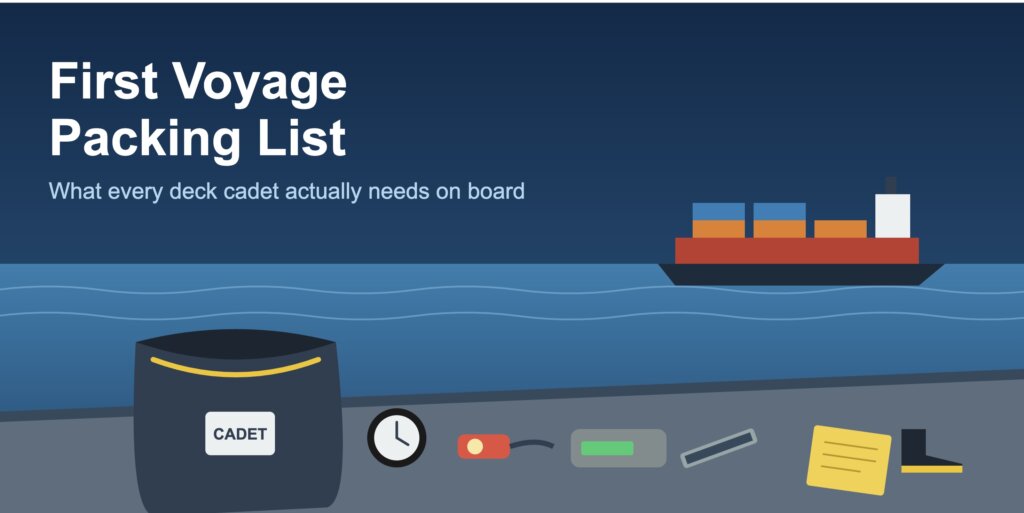
First Voyage Packing List: What Every Deck Cadet Actually Needs On Board
Your joining date is confirmed, the flight is booked, and now you are staring at an empty bag wondering what actually matters for four to six months at sea. Every cadet overpacks the wrong things and underpacks the right ones. This list is built from what junior officers wish someone had told them before their first contract, organized by what you will use daily, what will save a bad night, and what you can safely leave at home.
One rule before we start: you will carry this bag yourself up a gangway, through three airports, and sometimes up a pilot ladder. Aim for one duffel plus a small backpack, and nothing you cannot lift over your head.
The three things that decide your first month
Before the checklist, understand what the first weeks on board are really like. You will be tired, on an unfamiliar watch pattern, in cramped accommodation, often in weather you did not choose. Three pieces of kit have a disproportionate effect on how well you cope:
- A reliable, readable watch. Ship’s time, UTC, watch handovers, logbook entries — you will look at your wrist forty times a day.
- Sleep protection. Cabins are next to engine rooms, mooring decks, and crew who are awake when you are not. Our guide on seafarer sleep hygiene explains why this matters more than most cadets expect.
- A way to keep your phone and laptop alive on a ship where sockets are scarce, voltages vary, and Wi-Fi comes in twenty-minute rations.
Get those three right and the rest is comfort.
Documents and paperwork (non-negotiable)
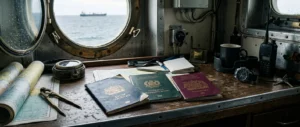
Pack these in your hand luggage, never in checked bags, and keep photocopies plus scanned copies in cloud storage:
- Passport (valid 12+ months beyond contract end) and seaman’s book / CDC
- STCW certificates: Basic Safety Training, PSCRB, Security Awareness, Medical First Aid as applicable
- Medical certificate (ENG1 / national equivalent) and vaccination records
- Training Record Book (TRB) — your entire cadetship depends on this
- Contract / letter of employment, joining instructions, agent contact
- Two dozen passport photos (visas, port passes, crew lists)
- A cheap folder or document wallet so nothing gets bent or wet
Watch: your most-used tool on board
A cadet’s watch needs three things: it must be legible in a dark bridge, waterproof enough for deck work, and cheap enough that losing it overboard is annoying rather than tragic. Skip smartwatches — battery life and sea spray are a bad combination, and many companies restrict them in secure areas anyway.
A rugged digital watch with a backlight, stopwatch, and dual time (ship’s time plus UTC) is the standard choice for good reason. The Casio G-Shock range and similar shock-resistant models survive years of mooring operations.
Rugged digital dual-time watch (G-Shock or equivalent)]
Sleep: earplugs, eye mask, and a small fan
Nobody warns you about the noise. Steel decks transmit every sound, and daytime sleep after a 00–04 watch is nearly impossible without help.
- Reusable silicone or foam earplugs with a high noise-reduction rating. Pack more than one pair — they get lost in bedding.
- A contoured sleep mask that blocks light without pressing on your eyes. Porthole covers are rarely complete.
- A small USB or clip-on fan. Cabin air-conditioning fails, ships sit in tropical ports, and a moving-air fan is the cheapest sleep aid you can buy.
If you want the full picture of watch rotations and rest, read our article on managing crew fatigue.
Seasickness: prepare before you feel it
Even cadets who “never get seasick” get seasick on their first bad-weather passage in the North Atlantic or Bay of Biscay. The mistake is waiting until you feel ill. Pack a small kit and start it before the weather arrives:
- Acupressure wristbands (drug-free, no drowsiness — useful on watch)
- Ginger capsules or chews
- Non-drowsy motion sickness tablets from your pharmacist (check with the ship’s medical officer before combining with anything)
We cover the physiology, the medication options, and the bridge-watch tricks in detail in Seasickness Management for Seafarers.
Power and connectivity
Assume one working socket in your cabin, possibly with a plug type you have never seen. Pack:
- A universal travel adapter with USB ports (ships built in Korea, Japan, China, Germany, and Croatia use different outlets).
- A high-capacity power bank (20,000 mAh or more) — for the bridge wing, the lifeboat drill, the twelve-hour airport layover.
- A compact multi-port USB charger so one socket charges everything.
- Long charging cables (bunks are never next to sockets) and a small extension lead if your company allows it.
Headlamp and small tools
A headlamp with a red-light mode is the piece of kit experienced officers most often say they wish they had bought earlier. You will use it for night rounds, tank inspections, cargo checks and reading in a dark shared cabin without waking anyone. Red mode preserves night vision on the bridge.
A compact multitool (pliers, blade, screwdriver) is genuinely useful — though check company policy on knives before you bring one, and never carry it through airport security in hand luggage.
Clothing and PPE
Most companies issue boiler suits, safety boots, helmet and gloves. Ask before you buy. What they will not issue:
- Thermal base layers (North Sea and Baltic winter watches are brutal; a Latvian cadet knows this, a Filipino cadet often learns the hard way)
- A quality waterproof jacket for going ashore and deck rounds
- Comfortable non-slip shoes for accommodation areas (safety boots are not worn in the mess)
- Flip-flops for the shower; communal showers are not always clean
- Enough underwear and socks for 10–14 days; laundry machines exist but queue on Sundays
- Two or three “shore” outfits; one smart set for inspections, agents, and port state control
- Sunglasses (polarised) and a cap for tropical bridge wings
Personal care and health
- Prescription medication for the full contract plus a month, with a copy of the prescription
- Basic first-aid: blister plasters, painkillers, antihistamine, rehydration sachets
- Sunscreen SPF 50, lip balm, good moisturizer (salt air and air-conditioning destroy skin)
- Quick-dry microfibre towel (ship towels are small and slow to dry)
- Nail clippers, tweezers, ear thermometer if you are cautious
Comfort, morale and learning
This category separates cadets who finish the contract in good shape from those who count the days:
- A notebook and good pens for the TRB, standing orders, checklist notes and questions for the chief officer. Waterproof notebooks exist and are worth it.
- An e-reader or tablet loaded with reference books before you leave — Wi-Fi at sea will not download them. Bowditch, the COLREGs, your company’s SMS, and something unrelated to ships.
- Downloaded music, podcasts, and films. A lightweight Bluetooth speaker is popular in shared cabins (with headphones for when it is not).
- Photos from home, a small treat (proper coffee, a jar of something from your country) — on day sixty these matter enormously.
- A deck of cards. Every good ship has a card game.
Quick comparison: the five items to buy first
| Item | Why it matters | What to look for | Link |
|---|---|---|---|
| Rugged digital watch | Used constantly on watch | Backlight, dual time, 100 m+ water resistance | [AMAZON-LINK] |
| Earplugs + sleep mask | Daytime sleep after night watch | NRR 30+, contoured mask | [AMAZON-LINK] |
| Headlamp (red mode) | Night rounds, dark cabins | Rechargeable, 200+ lumens, red LED | [AMAZON-LINK] |
| 20,000 mAh power bank | Scarce sockets, long transits | USB-C PD, airline-legal capacity | [AMAZON-LINK] |
| Acupressure wristbands | Seasickness without drowsiness | Adjustable, washable | [AMAZON-LINK] |
What to leave at home
- Expensive jewelry and a second laptop; theft is rare, but loss is permanent
- Drones (banned in most ports and on most ships)
- Large hard-shell suitcases (nowhere to store them in a cabin)
- Anything you would be devastated to have confiscated at customs
- More than two books in paper form; use the e-reader
Final checks the night before
Weigh the bag. Charge everything. Put documents and one change of clothes in hand luggage in case checked bags are delayed, ships do not wait for luggage. Save the agent’s number and the ship’s IMO number on your phone. Then sleep; it may be the last full night for a while.
Your first ship is where you learn to be a seafarer. Good kit does not make you a good officer, but it removes the small miseries that get in the way of learning. Pack light, pack smart, and enjoy the watch.
Disclosure: As an Amazon Associate, seafarertrainings.com earns from qualifying purchases made through links in this article. Prices and availability are accurate at time of publication and may change.
This article was created with AI assistance and reviewed by a human editor.
Future articles this post should later link to (gear cluster):
- Best Watches for Seafarers (dedicated buying guide)
- Best Headlamps for Ship Work
- Books Every Deck Cadet Should Read Before Joining
- Staying Connected at Sea: Power, Wi-Fi and Phone Plans