Most seafarers reach a point where they’ve completed basic STCW, and the next question is which extra certificate to pay for. The answer depends on the vessel and the job. A dynamic positioning (DP) course does nothing for someone aiming at LNG carriers, and a gas cargo endorsement does nothing for an offshore support vessel (OSV) career. Specialized vessel certifications are tied to vessel types, so choosing one without knowing your target ship is the most common way to waste money on the wrong course.
This article sorts the main specialist certificates by destination: DP vessels, gas carriers, and offshore support and installation work. For each, it covers what the certificate unlocks, what usually comes first, and who decides whether it is required. Course names, durations, and approval rules change, and they differ by flag state and employer, so treat this as a map for asking better questions rather than a replacement for the answers.
Why basic STCW is the starting requirement, not the whole requirement
Basic STCW training covers personal survival techniques, fire prevention and firefighting, elementary first aid, and personal safety and social responsibilities. It qualifies you to serve on a seagoing ship in general. If you need a refresher on how the convention is structured, what STCW certification is, and what every seafarer needs, a separate article covers it, and the certificates lay out the deck progression that marks each rung of the deck ladder.
Specialist vessels add hazards and operations the basic course doesn’t cover. A gas carrier moves flammable or toxic cargo, often at very low temperatures or under pressure. A DP vessel holds position using thrusters and sensors instead of anchors, and a failure can put it into contact with a platform or subsea equipment. An offshore installation can be reached only by helicopter or by transfer from a vessel, and evacuation means leaving in the sea.
Three different parties can require a specialist certificate, and it helps to know which one you are dealing with:
- The flag state or maritime administration. Some endorsements are statutory. STCW itself sets mandatory training for personnel on oil, chemical and liquefied gas tankers, for example.
- The employer or charterer. Many requirements are commercial. A client may require a specific DP certificate or offshore survival standard for everyone on a contract, even when no regulation requires it.
- The installation or regional operator. An offshore site or regional scheme may require its own induction or a named safety standard before you can board.
A certificate can be legally sufficient and still be refused at the gate. The sections below flag which party usually makes the call for each one.
Dynamic positioning: the training path and who needs it
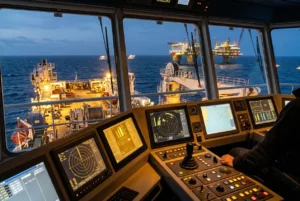
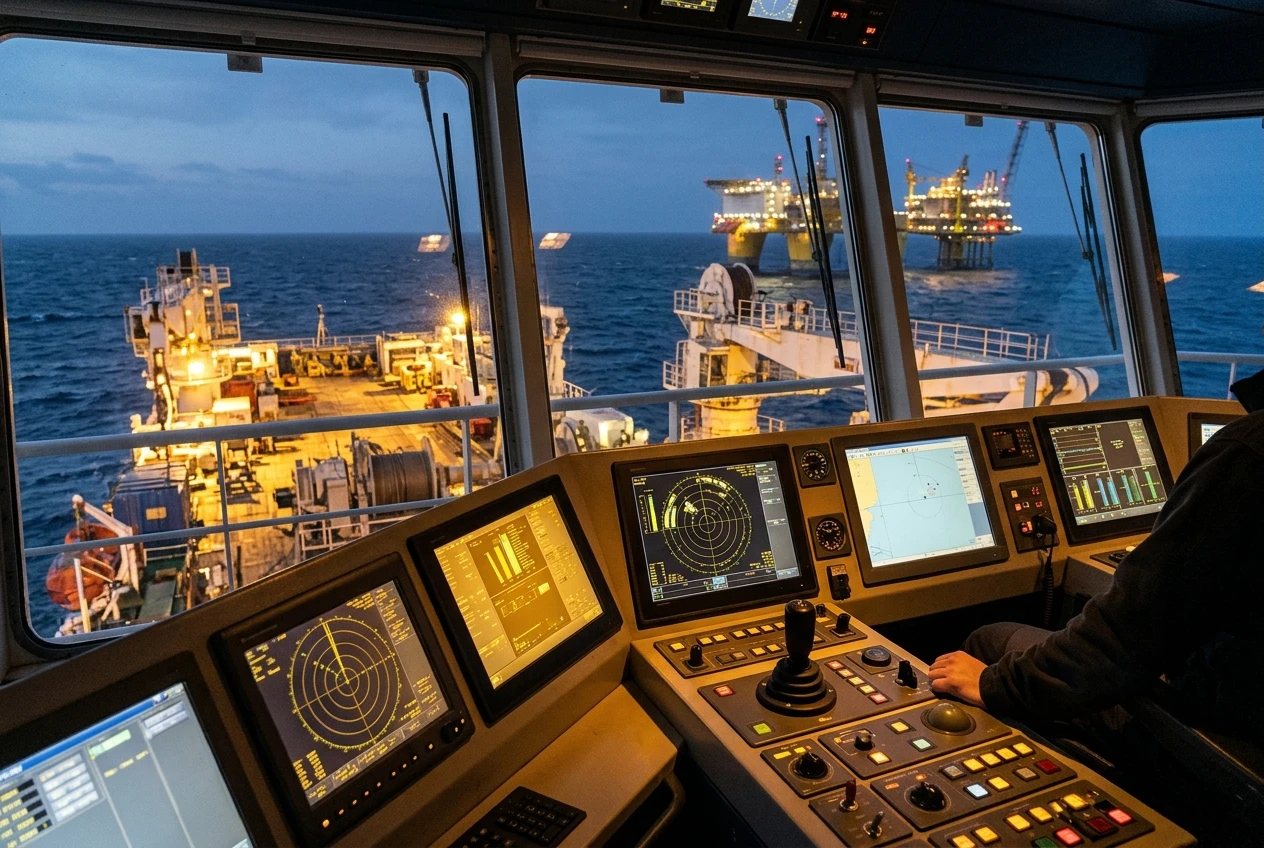
DP certification matters mostly to deck officers, and in some cases engineers, on vessels that hold station by computer-controlled thrust. That includes many offshore supply and construction vessels, drilling units, cable and pipe layers, and some survey and shuttle tanker work. The central role is the dynamic positioning operator (DPO).
What it unlocks
A DP certificate is the entry requirement for the DPO seat on the bridge. It also marks you as a candidate for the senior roles on DP vessels, where a company will not promote someone who cannot run the system. For officers who want to work in offshore construction or drilling support, it is often the largest single career step after the standard deck or engine certificates.
What usually comes first
The widely used scheme is administered by the Nautical Institute, and its path is generally described as a sequence:
- An induction course covering DP theory, system components and basic operation.
- Simulator training, where you practice operating the system and handling failures.
- A period of supervised sea time on a DP vessel, recorded in a DP logbook and signed off.
- An advanced course, followed by a certificate issued after the sea-time and course records are reviewed.
The details matter. You must open and keep the logbook properly from the start, and the sea time must be on a vessel in a role the scheme accepts. A common problem is finishing the induction and then not finding a berth that lets you accumulate logged time. Before you pay for the first course, ask whether your employer can place you on a DP vessel afterward, and whether the company will sign the logbook.
There are also different certificate grades. Some are limited to specific vessel types or systems, and others are unrestricted. Which one a company expects depends on the vessel’s DP class and the client’s rules.
Who decides it is required
Mostly the market, not a single regulation. Flag states and class societies reference DP competence in various ways, but in practice charterers, vessel operators, and clients set the minimum DPO qualification for a given contract. If a job advert names a specific DP certificate, that is your requirement, and you should confirm with the employer whether another scheme’s certificate would be accepted before you book anything.
Gas tanker endorsements: what separates basic and advanced cargo training
Gas carriers (LNG and LPG vessels, and others carrying liquefied gases) have their own tier of STCW training. It sits in regulation V/1-2, the liquefied gas counterpart to the oil and chemical tanker provisions. It has two levels, and mixing them up is a common mistake.
Basic training for liquefied gas tanker cargo operations
The basic level is for personnel who have specific duties and responsibilities related to cargo or cargo equipment on a gas tanker. It covers the properties and hazards of liquefied gas cargoes, the safety aspects of gas ship operations, the shipboard systems involved, and emergency procedures such as fire and gas leak response. Ratings assigned cargo-related duties and junior officers typically start here.

Advanced training for liquefied gas tanker cargo operations
The advanced level is aimed at those with immediate responsibility for loading, discharging, care in transit, handling of cargo and tank cleaning. In practice, that means the master, chief officer, chief engineer, second engineer, and anyone else in charge of cargo operations. It goes deeper into cargo-handling theory, calculations, planning, and the operation of cargo systems.
What usually comes first
STCW sets out the prerequisites for the advanced level, and each administration applies them. In general, you need to have completed the basic gas tanker training and have a period of approved sea service on gas tankers. The issuing administration decides the exact length and what counts, so ask before you assume your previous time qualifies. Because a gas carrier is a specific ship type, the sea service usually has to be on a comparable ship, not on a general cargo vessel.
Gas carriers also have type-specific differences. LNG, LPG and ethylene carriers have different containment systems and cargo behavior, and employers often add their own familiarisation or simulator courses on top of the STCW certificate.
Who decides it is required
The flag state decides, because the training is statutory for personnel with defined cargo duties, and your endorsement is recorded on your certificate of proficiency. Employers then add their own requirements for experience, vetting and company courses. If you have only done the oil and chemical tanker training, it does not substitute for the gas version.
Offshore safety certificates: the survival and emergency courses that get you through the gate
Offshore work covers platform supply and standby vessels, crew transport, construction support and work on fixed or floating installations. These are the areas where offshore safety training is a condition of access, not a bonus.
The core survival and emergency courses
The courses you see most often come from industry standards, such as OPITO, and regional equivalents. Typical components include:
- Basic offshore safety induction and emergency training, often shortened to BOSIET. It covers sea survival, firefighting and first aid in an offshore context, and emergency response.
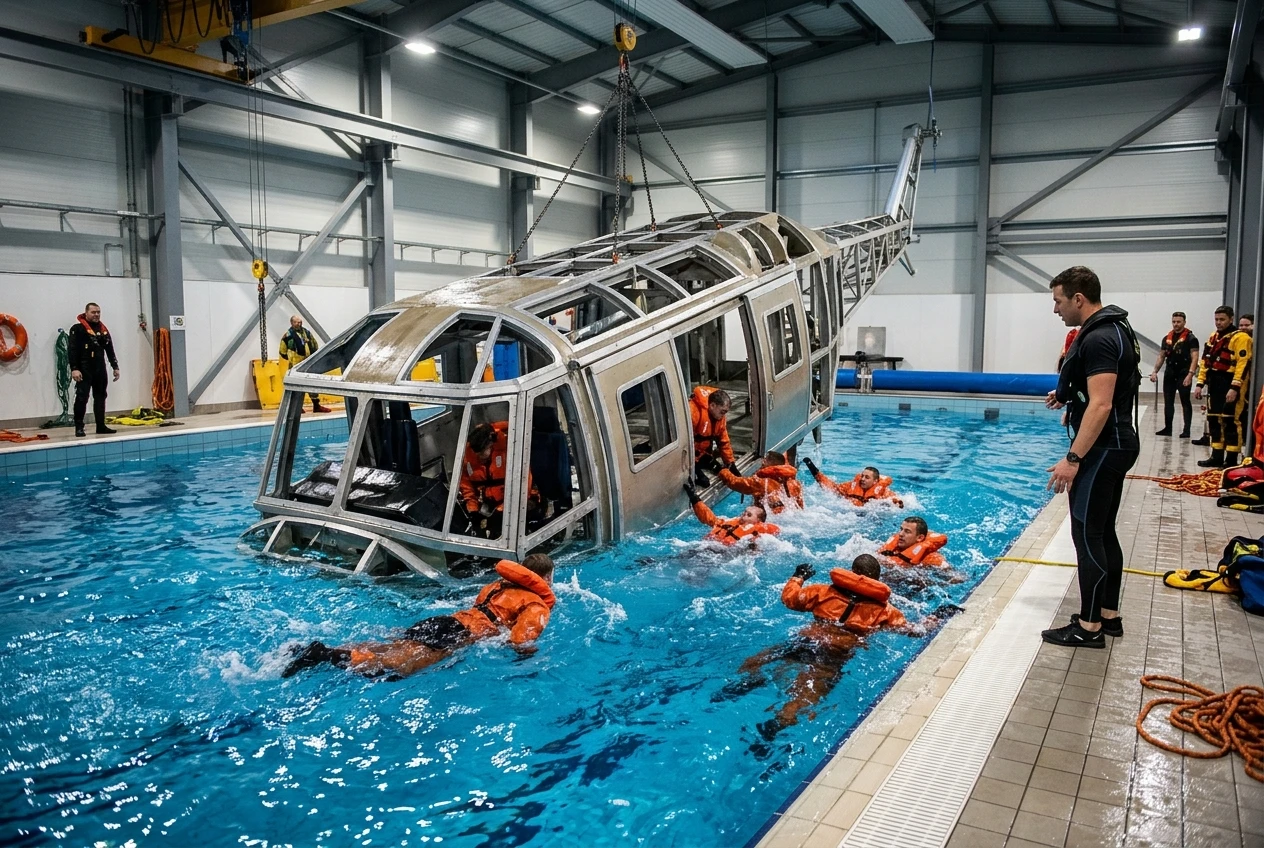
- Helicopter underwater escape training (HUET), which teaches you to escape from a ditched and inverted helicopter. It is usually bundled with BOSIET for people who will fly to installations.
- Further offshore emergency training (FOET) and similar refresher courses renew survival certificates before they lapse.
- Regional induction schemes, such as the UK’s MIST for construction and installation, or national standards in Norway and the Netherlands. The scheme required varies by region and client.
Some of these include a medical component. An offshore medical, separate from the seafarer’s own, is often required before you can attend or travel, and it is distinct from your seafarer certificate. For a comparison of seafarer medicals, see what happens at your ENG1 medical.
What usually comes first
You generally need basic STCW safety training and a valid medical. Most offshore survival providers also expect you to be physically able to complete water-based exercises, and a few will ask for a swimming declaration. Check this before you book, because turning up unable to take part generally means losing the fee.
Who decides it is required
The installation operator, the client, and your employer decide. A vessel crew that never transfers to an installation may need less than the people who do. The key question to ask a recruiter is which standard the contract names, and whether an older certificate or an equivalent from another region will be accepted.
Matching certificates to the job: a vessel-type cheat sheet
The table below matches the main destinations to the certificates covered above. Use it to form questions for an employer. It does not state what any particular company or flag state will accept.
Target job Likely specialist certificates Usually decided by DPO or DP-qualified officer on an OSV, drill ship or construction vessel DP induction, simulator course, logged DP sea time, advanced course and DP certificate; offshore safety courses if the work involves installations Employer, charterer or client; sometimes flag state Rating or junior officer with cargo duties on a gas carrier STCW basic training for liquefied gas tanker cargo operations Flag state, applied by the employer Master, chief officer, chief engineer or second engineer on a gas carrier Basic plus advanced training for liquefied gas tanker cargo operations, with approved gas tanker sea service Flag state; employer adds experience requirements Crew on platform supply or standby vessels Offshore survival and emergency training, plus any regional induction scheme; DP if on the bridge Employer and client Anyone transferring to or working on an offshore installation BOSIET with HUET (or the regional equivalent), an offshore medical where required, and site induction Installation operator and client
Some careers combine several rows. A DPO on a vessel supporting offshore installations may need the DP certificate and the survival courses. A gas carrier officer usually needs only the gas endorsements, plus company courses. Oil and chemical tankers, not covered here, have their own STCW tanker training under regulation V/1-1, separate from the gas version.
How to sequence your courses so you do not pay for the wrong one first
Order matters because several certificates depend on others, and some expire. A sensible sequence reduces the risk of paying for something you cannot use yet.
- Settle the target vessel type first. Pick the destination before the course. If you are undecided between DP and gas, speak to someone who works in each before you pay for either.
- Confirm the foundations are valid. Basic STCW certificates and your medical need to be in date. Most specialist courses require them at enrolment.
- Find out whether you need sea time or experience before the course. The advanced gas training and the DP certificate both depend on time served. Book the course that you are already eligible for, not the one that sounds more senior.
- Ask your employer whether they sponsor or require a named provider. Some companies pay for courses or recognize only certain providers. Paying out of pocket first can mean you have to repeat the course.
- Check validity periods. Offshore survival certificates have limited validity and need renewal. If you complete one month before you can start work, it may expire before you use it. Ask the provider for the current validity period and plan around your start date.
- Open the logbook early when needed. For DP, the logbook records the sea time. Starting it late can mean your time served isn’t counted.
- Do not stack unrelated specialisms. A gas endorsement and a DP certificate serve different careers. Hold off on the second until you’re using the first, unless a specific job needs both.
Choosing the provider is part of the sequence too. Choosing a maritime training academy covers what to look at before you enroll, such as approvals, facilities, and what the fee includes.

Checking that a certificate is valid: flag state, employer and provider approval
A certificate is only useful if the party that has to accept it does. Three checks cover most problems.
Flag state or administration. For statutory endorsements, such as gas tanker training under STCW, the course must be one your issuing administration recognizes, and that administration must enter the endorsement on your certificate or documents. If you are going to serve under a different flag than the one that issued your certificate, ask about its recognition and endorsement rules. Do not assume that a course accepted by one administration is accepted by another.
Employer or client. For commercial requirements, such as a DP certificate, an offshore survival standard or a particular induction, the final authority is the company or client on the contract. Ask in writing which certificates and which issuing bodies they accept, and keep the answer. An equivalent certificate can still be rejected if the client’s rules name something else.
Provider approval. Check that the training center is approved for the specific course you are buying. A maritime administration or accrediting body usually grants approval for a particular standard, and a center may be approved for some courses but not others. For schemes like the Nautical Institute DP scheme or the OPITO standards, the issuing body maintains lists of accredited or approved centers. Ask the provider for its approval details and check them with the approving body, not only on the provider’s own website.
Some practical checks before you pay:
- Ask what certificate you will receive, who issues it, and whether it names the standard the employer asked for.
- Ask for the validity period and the renewal route.
- Keep copies of course records, sea-time sign-offs and logbook entries, since you may need them for later endorsements.
- Confirm with the employer, the flag state, and the provider before you commit, because rules and approvals change, and no article can tell you where your case stands.
Once a certificate is issued, check its details against your passport and seafarer documents. Name spelling and date errors are easier to fix before you hand the certificate to an employer than after.
This article was created with AI assistance and reviewed by a human editor.
Disclosure: This post contains Amazon affiliate links. If you buy through them, we may earn a small commission at no extra cost to you