Dangerous goods rules are usually presented as a shipper’s problem, a matter of forms completed ashore before a box reaches the terminal. Once the box is on the quay, the ship takes over the chain of duties. The IMDG Code requirements for seafarers cover what happens between the gangway and the discharge port: checking, stowing, monitoring and responding.
This article follows one packaged consignment through that chain, a container of drummed or boxed dangerous goods, and marks what a deck officer, cadet, or rating is personally expected to verify at each point. It covers packaged goods only. Tanker bulk cargo falls under different rules and is covered separately.
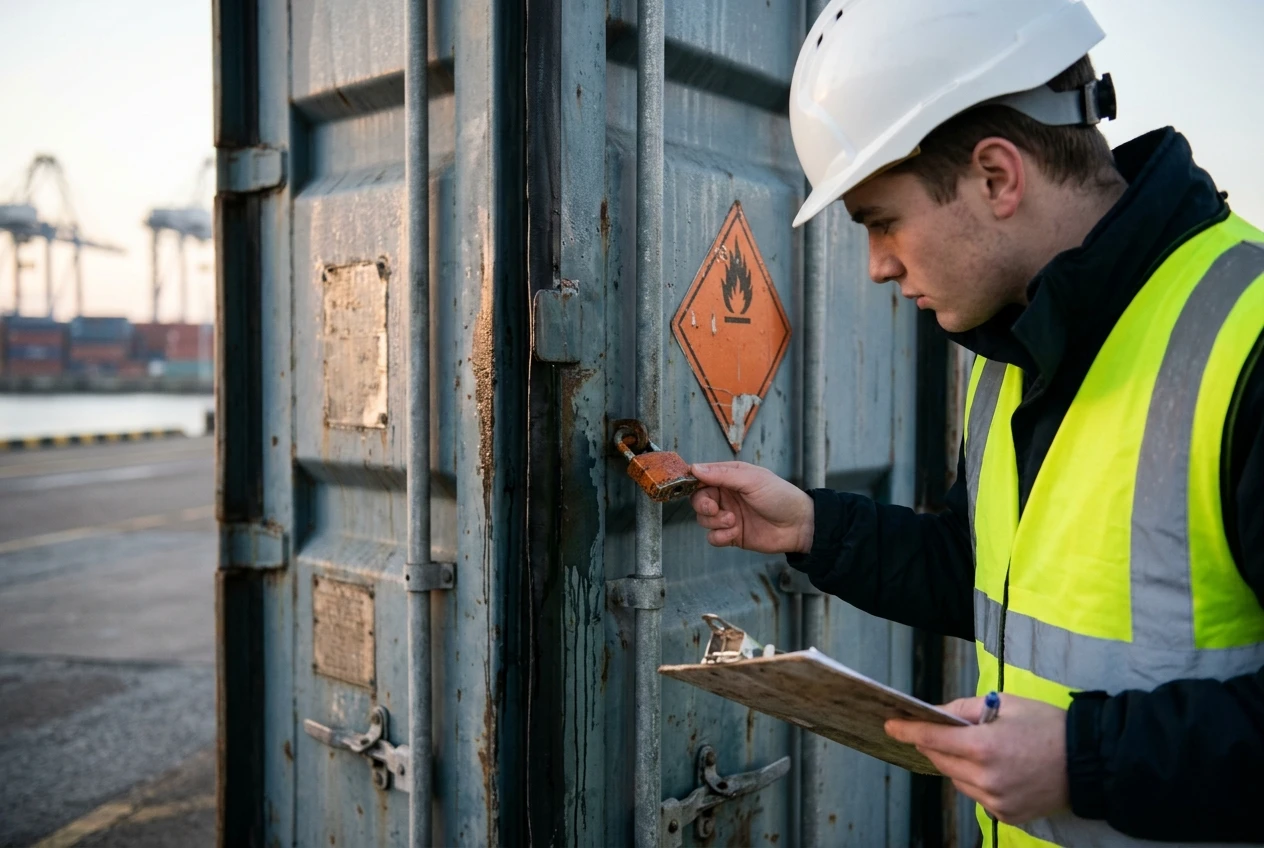
Why dangerous goods compliance lands on the person on deck, not just the shipper
The shipper is legally responsible for correctly classifying, packing, marking, and declaring the cargo. That responsibility does not transfer to the ship, but it does not remove the ship’s duties either. The Code assumes errors exist, and the ship is the last point where someone can catch one before the cargo is at sea with the crew.
In practice, the person most likely to notice a problem is whoever is standing next to the container. A rating on the lashing gang sees a stain on the door seal. A cadet checking the manifest sees a UN number that does not match the label. The chief officer sees a stowage request that puts two incompatible cargoes in adjacent bays. Each of these people holds a small piece of the compliance picture, and the system only works if each one speaks up.
Two points about editions and authority apply throughout:
- The IMDG Code is amended on a two-year cycle, so check which edition is in force on your ship, and use that edition rather than an old copy kept in the cargo office.
- Your flag state and company procedures may add to the Code. Where they are stricter, follow them.
Reading the hazard classes and labels well enough to spot a problem
The Code has nine classes. You do not need to memorize every entry in the Dangerous Goods List, but you should know the classes well enough to notice when something looks wrong:
- Explosives
- Gases (flammable, non-flammable, toxic)
- Flammable liquids
- Flammable solids, substances liable to spontaneous combustion, and substances that give off flammable gas when wet
- Oxidizing substances and organic peroxides
- Toxic and infectious substances
- Radioactive material
- Corrosives
- Miscellaneous dangerous substances, which include lithium batteries and environmentally hazardous substances
Each package should carry a diamond-shaped hazard label for its class, plus the UN number and proper shipping name. A package with a subsidiary hazard carries a second label. Marine pollutants carry their own mark. Containers carry placards, and the UN number should be displayed on them.
When you look at a unit, ask a few plain questions. Does the label color and symbol match the class on the paperwork? Is the placard on all four sides? Is anything faded, torn, painted over, or covered by another label? A missing or mismatched mark is a finding to report, not something to fix on your own.
Checking the dangerous goods declaration and the container before it comes aboard
The pre-loading check is the first real opportunity to stop a problem. Compare the dangerous goods declaration against the ship’s booking information and against what you can see on the unit. The declaration should give, for each item:
- the UN number and proper shipping name
- the hazard class, and any subsidiary hazard
- the packing group, where one applies
- the quantity and the number and type of packages
- whether the substance is a marine pollutant
- the flashpoint, where it is required
- an emergency contact
For cargo packed into a container or vehicle, a packing certificate should accompany the declaration, confirming that the unit was packed and secured properly and that incompatible goods were not packed together. The declaration must be signed by the shipper.
Then look at the unit itself. Check for:
- damage to the structure or door seals
- leaking residue, stains or wet patches
- bulging sides or an odd smell
- missing or damaged placards
- a seal number that does not match the paperwork

If the declaration is incomplete, the UN number does not match the label, or the unit looks damaged, the safe response is to stop the load and tell the chief officer. The pressure to keep the schedule is real, but cargo that is loaded cannot easily be unloaded at sea.
Stowage and segregation: where a consignment can and cannot go
Once the paperwork passes, the Dangerous Goods List tells you where the cargo may go. Two columns matter most. One gives the stowage and handling requirements, including the stowage category (A to E) that governs whether the unit may travel on deck, under deck, or either, and whether the rules differ between cargo ships and passenger ships. The other gives segregation requirements specific to that substance.
Segregation between different dangerous goods follows the Code’s segregation table and its container stowage table. The terms are defined with increasing separation:
- Away from: effectively separated so that incompatible goods cannot interact in an incident, but they may be in the same compartment or on deck with a specified gap.
- Separated from: in different compartments or holds, or with a larger deck distance if stowed on deck.
- Separated by a complete compartment or hold from: a full compartment or hold between them.
- Separated longitudinally by an intervening complete compartment or hold from: the same, with the added requirement that the gap runs fore and aft.
Those terms have exact meanings in the Code, so read the relevant section rather than relying on how they sound. Other stowage rules go beyond segregation: keep goods away from heat sources such as engine casings and heated tanks, and away from accommodation and ventilation intakes. Some goods need to stay accessible for inspection.
Segregation can break at three points. The stowage plan is made before the final cargo list is known. Late bookings get slotted into gaps. Cargo is shifted after a port call. Whenever the plan changes, someone must recheck it against the segregation requirements. Plugging a reefer unit in next to a dangerous consignment, or discharging and reloading around it, is where errors tend to creep in.
Watching the cargo during the voyage: ventilation, temperature and leaks
Compliance does not end when the lashings are tight. Some dangerous goods need active monitoring, and the Dangerous Goods List and the ship’s cargo documents tell you which.
Ventilation. Certain cargoes need ventilation in the hold or space where they are stowed, and the Code covers ventilation requirements for enclosed spaces. If a hold needs mechanical ventilation, the fans must be working, and their operation should be checked and recorded, not assumed.
Temperature. Some substances, such as certain organic peroxides and self-reactive substances, have a control temperature and an emergency temperature. These units rely on refrigeration. If the reefer alarm sounds, or the set-point drifts, the issue is a safety one and goes straight to the officer of the watch and the chief officer. A rising temperature in a temperature-controlled unit can become an emergency quickly.
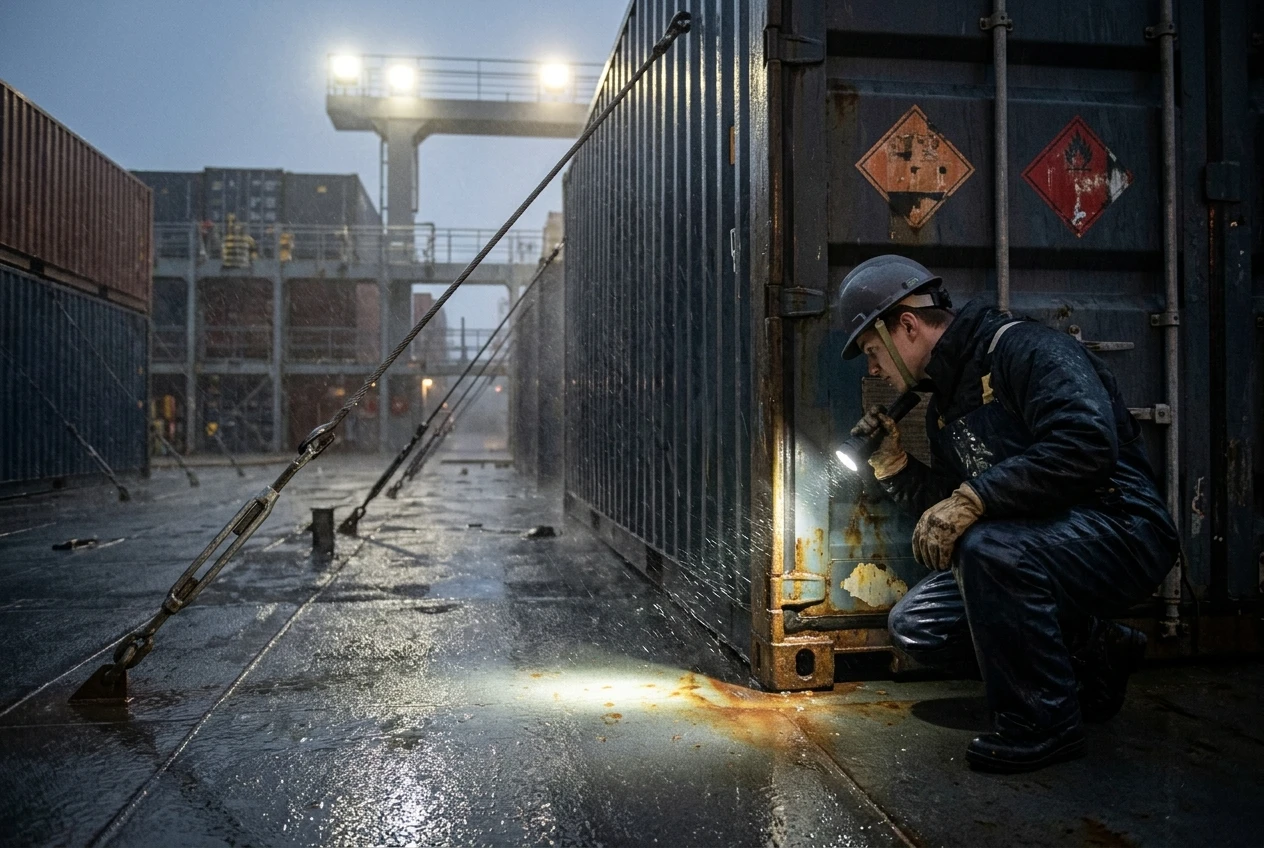
Leaks and damage. Rounds should include a look at dangerous goods stowed on deck: signs of leakage, vapor, staining, discoloration of paint or lashings, damaged units after heavy weather, or shifted cargo. Report what you see. Do not open a unit you suspect is leaking, and do not approach one without the right protective equipment and instruction from the officer in charge.
Water-reactive substances and some other classes can react badly to wet conditions, so heavy weather and water ingress matter more for those goods. Record each inspection in the ship’s log or the cargo record, including checks that found nothing wrong, because a blank entry looks the same as a skipped check.
Emergency response: using the EmS guide, the PPE and the muster plan
When something goes wrong, the ship’s emergency response for packaged dangerous goods starts with identification. Find the UN number from the declaration or the placard, and look it up in the Dangerous Goods List. It points to the relevant Emergency Schedules (EmS): one for fire (an F schedule) and one for spillage (an S schedule). The guide tells you what to do and, just as important, what not to do. For example, using water on a fire may be correct for some cargoes and dangerous for others.
Medical first aid for people exposed to a substance follows the Medical First Aid Guide (MFAG) or the equivalent guidance your ship carries. Know where that guidance is kept and who is responsible for medical care on board. If you need background on seeking medical help at sea, the site has a separate piece on accessing medical care while at sea.
Ships carrying dangerous goods are required under SOLAS to have protective clothing and breathing apparatus in addition to the normal firefighting equipment. As a crew member, you should know:
- where that equipment is stored
- how to put it on correctly, and who is trained to use it
- how it is checked and maintained
- which emergency party you belong to under the muster list
A drill is the right time to find out that a breathing apparatus cylinder is empty or that the protective suit is the wrong size, not an actual incident. Emergency response is team-based and run by the master and the designated officers, so follow the muster plan and the instructions you are given. Improvising near an unknown or misidentified substance is how a manageable incident turns into a casualty.
Afterward, incidents involving dangerous goods, including packages lost overboard, usually carry reporting obligations to the flag state and the relevant coastal authorities. The master and company handle that, but the detail they report depends on what you observed and noted.
Records, training and certificates that prove you were competent
If something goes wrong, the first questions are about documents. Was the declaration checked? Was the stowage plan reviewed against the segregation requirements? Was the cargo inspected, and who signed? Were crew trained for their role? Your records are your protection as well as the ship’s.
Chapter 1.3 of the IMDG Code requires that everyone involved in the carriage of dangerous goods is trained for their function, covering general awareness, function-specific training and safety training. The employer is responsible for providing and recording that training, but you should keep your own copies of anything you complete. STCW certification sets the baseline for seafarers, and officers’ competence frameworks include handling and monitoring dangerous cargoes. Basic safety training does not make you competent to stow a particular dangerous goods cargo, so check what your company and flag state require for your rank and duties. The STCW certification explained article covers what the convention does and does not require.
Practical habits that help:
- Keep copies of training certificates and refresher dates where you can find them quickly.
- Note the IMDG Code edition you were trained on and when the next amendment cycle applies.
- Sign what you checked, and only what you checked.
- If you raised a concern about a consignment, make sure it is recorded in writing, not only remembered.
Where to go next: tanker cargo, specialist certificates and STCW basics
Packaged dangerous goods are one part of cargo safety. If you move to tankers, the hazards, equipment and procedures change substantially, and the tanker safety procedures article follows them from loading to discharge.
Some vessel types need certificates beyond the basic set, such as gas tanker endorsements or offshore safety training. The comparison of specialist certificates by vessel type shows which apply to which ships, so you can plan training before a posting rather than after.
For deck officers aiming at the chief mate role, where responsibility for the cargo plan and its compliance sits, the piece on chief mate training requirements covers the cargo planning side in more depth.
The chain of duties described here has four points: the declaration check, stowage and segregation, monitoring during the voyage, and emergency response. A failure at any one of them can be caught at the next, but only if the person there knows what they are verifying. Learn the part of the chain you are responsible for, and know who to tell when it fails.
This article was created with AI assistance and reviewed by a human editor.
Disclosure: This post contains Amazon affiliate links. If you buy through them, we may earn a small commission at no extra cost to you.